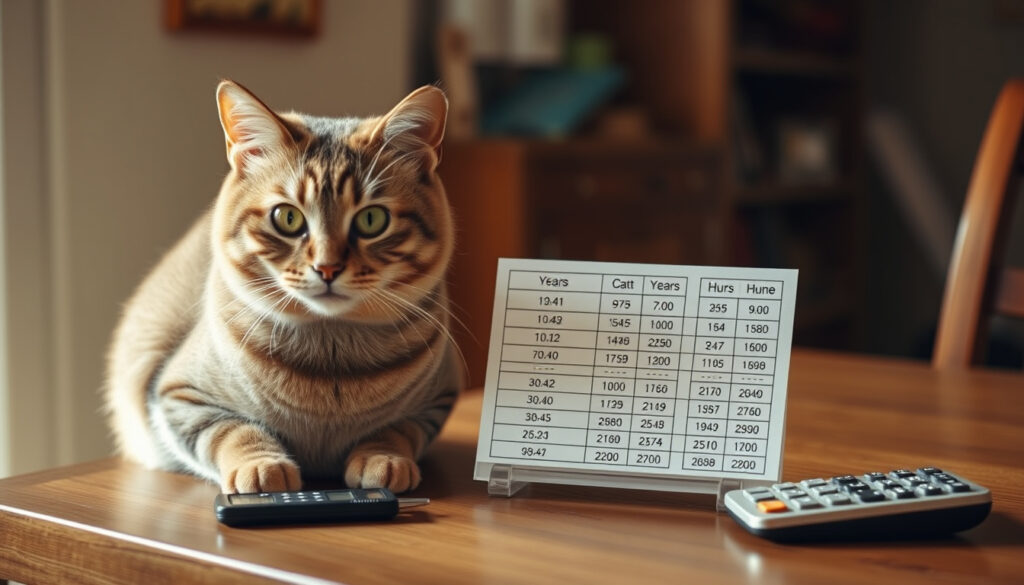
Cat Years to Human Years: Conversion Chart & Calculator
That moment you look at your cat and wonder how old they would be in human years is a window into their health, behavior, and needs. The answer isn’t a simple multiplier; it follows a vet-backed formula that reveals why a two-year-old cat is already a young adult and a 15-year-old is a wise senior, helping you adapt care to their real-life stage.
First cat year: 15 human years ·
Second cat year: 24 human years cumulative ·
Each subsequent year: 4 human years ·
Average cat lifespan: 12–18 years ·
Common conversion formula: 15 + 9 + 4 × (n – 2) for n > 2
Quick snapshot
- First two years = 15 + 9 = 24 human years (Adopt a Pet (pet adoption resource))
- Each year after age 2 adds ~4 human years (IAMS (pet nutrition brand))
- AVMA and veterinary consensus supports this formula (catvets.com (veterinary medical association))
- Exact aging varies by breed (e.g., Siamese may age slower)
- Lifestyle (indoor vs. outdoor) affects longevity
- Individual health and genetics play a large role
- Cat age progression is non-linear: rapid aging in first two years, then steady 4:1 ratio (Chewy (pet retailer with vet-reviewed content))
- By 10 years a cat is roughly 56 human years — early senior stage (Chewy (pet retailer with vet-reviewed content))
- Use the chart or calculator to pinpoint your cat’s human age
- Adjust diet, vet visits, and enrichment based on life stage
- Monitor behavior changes that signal aging or discomfort
Here are the key conversion points from the 15-9-4 rule, from kitten to senior.
| Cat age | Human equivalent |
|---|---|
| First year | 15 human years |
| Second year | +9 = 24 |
| Third year | +4 = 28 |
| Fourth year | +4 = 32 |
| Fifth year | +4 = 36 |
| Tenth year | 24 + (8 × 4) = 56 |
How old is my cat in human years?
What is the cat years to human years formula?
The most widely accepted formula — used by veterinary organizations and major pet brands — is: 15 human years for the first year, plus 9 for the second year, then 4 human years for each additional year. This gives a 2-year-old cat about 24 human years, a 5-year-old cat about 36, and a 10-year-old cat about 56 (Litter-Robot (pet product brand); Omni Calculator (science-based calculator platform)).
- Count your cat’s age in years.
- If your cat is in their first year, assign 15 human years.
- If in the second year, add 9 to the total (making 24).
- For each year after age 2, add 4 human years.
How to use a cat age chart
A comparison table helps you see the pattern at a glance. Here are six milestones from kitten to geriatric, based on the 15-9-4 rule and life-stage guidelines from the AAHA/AAFP Feline Life Stage Guidelines (veterinary authority).
| Life stage | Cat age | Human equivalent | Key behaviors & needs |
|---|---|---|---|
| Kitten | 0–1 year | 0–15 | High energy, socialization, vaccinations |
| Junior | 1–2 years | 15–24 | Sexual maturity, independence, playfulness |
| Prime | 3–6 years | 28–40 | Active, healthy, routine vet care |
| Mature | 7–10 years | 44–56 | Slowing down, monitor weight, dental checkups |
| Senior | 11–14 years | 60–72 | Regular vet checkups, joint health, diet adjustments |
| Geriatric | 15+ years | 76+ | Specialized care, comfort, frequent monitoring |
The pattern: rapid aging in the first two years, then a steady 4:1 crawl. That means your 7-year-old cat is already middle-aged — time to start senior wellness checks.
Why knowing your cat’s human age matters
Translating cat years into human terms helps you spot age-related changes earlier. A 10-year-old cat at 56 human years is entering senior territory; you should watch for reduced activity, weight gain, or dental issues (Adopt a Pet (pet adoption resource)). It also lets you match enrichment — interactive toys for a young adult, soft beds for a senior. The International Cat Care (non-profit feline welfare organization) defines seven life stages that align closely with this human-age framework.
A cat owner who knows their cat’s human age can make smarter decisions about food, vet visits, and play. The formula is a tool, not a rule — but it’s the best tool we have.
What annoys cats the most?
Common noises that stress cats
- Loud appliances — vacuum cleaners, hair dryers, thunder (PAWS Chicago (animal shelter with vet expertise))
- Sudden sounds — doorbells, alarms, shouting
- High-frequency noises — some cats react to electronic beeps
How to create a calm environment
Cats thrive on predictability. Keep litter boxes clean (scoop daily), establish feeding and play routines, and provide quiet hideaways. Avoid forcing handling when the cat is clearly irritated — tail twitching or flattened ears means back off (The Cat Doctor (UK veterinary practice)).
Signs your cat is annoyed
- Tail twitching or thrashing
- Ears flattened sideways (airplane ears)
- Growling, hissing, or swatting
- Hiding or avoiding interaction
The implication: a calm, predictable environment reduces stress and strengthens your bond with your cat.
What is “I love you” in cat language?
Slow blinking
A slow, deliberate blink from your cat is the feline equivalent of a kiss. When you slowly blink back, you’re saying “I trust you” (International Cat Care (non-profit feline welfare organization)).
Tail language
- Straight up with a quiver: Pure affection — “I’m happy to see you.”
- Question-mark shape (hook at tip): Playful and friendly.
- Puffed tail: Fear or agitation — give space.
Purring and kneading
Purring often signals contentment (though cats also purr when stressed). Kneading — pressing paws rhythmically into a soft surface — is a comfort behavior carried over from kittenhood. Both are high-praise signs from your cat (Chewy (pet retailer with vet-reviewed content)).
A cat that slow-blinks then turns its back is giving you the ultimate trust signal. Reciprocate with a slow blink — then let the cat decide if it wants a pet.
The pattern: learning your cat’s love language deepens mutual trust and reduces misunderstandings.
What smell do cats absolutely hate?
Citrus and vinegar
Most cats recoil from lemon, orange, and lime. Vinegar’s sharp scent is also a strong repellent. These can be used safely to keep cats off countertops or furniture.
Essential oils to avoid
- Lavender, eucalyptus, tea tree, and peppermint oils are toxic to cats — never use in diffusers or topical applications.
- Phenols in many essential oils can cause liver damage (International Cat Care (non-profit feline welfare organization)).
How to use scents safely
If you want to deter a cat, use citrus peels or white vinegar diluted with water (never on skin). Keep all concentrated essential oils out of reach.
What fruit can cats not eat?
Grapes and raisins
Grapes and raisins can cause acute kidney failure in cats — even small amounts are dangerous (PAWS Chicago (animal shelter with vet expertise)).
Onions and garlic
All alliums — onions, garlic, chives — damage red blood cells and can lead to anemia. Avoid in any form (raw, cooked, powdered).
Safe fruit treats
- Small amounts of blueberries, melon, or banana are okay as occasional treats.
- Always remove seeds and rinds.
- Treats should make up no more than 5% of daily calories.
Where to rub your cat?
Preferred petting zones
- Cheeks and chin — glands release friendly pheromones.
- Base of the tail — many cats love a gentle scratch there.
- Back (along the spine) — light strokes.
Reading your cat’s body language
If your cat leans into your hand, purrs, or raises its hindquarters, keep going. If the tail starts twitching, ears flatten, or skin ripples (hindquarter twitch), stop — you’re overstimulating (The Cat Doctor (UK veterinary practice)).
Avoiding sensitive areas
The belly is a trap zone for many cats — even if they roll over, petting the belly can trigger a bite reflex. Paws and tail base are also often sensitive.
How do I say sorry to my cat?
Understanding cat forgiveness
Cats don’t hold grudges the way humans do, but they will avoid you if they associate you with a negative experience. Rebuilding trust takes consistent calm behavior.
Using treats and calm voice
- Offer a high-value treat (freeze-dried chicken or fish).
- Speak in a soft, high-pitched tone — cats respond to gentle voices.
- Slow blink at your cat while saying their name softly.
Rebuilding trust
Give the cat space — don’t pursue. Let them come to you. Once they approach, offer a scratch under the chin without staring. Over a few days, the routine will reset the relationship (International Cat Care (non-profit feline welfare organization)).
The implication: consistent calm actions will rebuild trust over time.
“The first year of a cat’s life is considered the equivalent of 15 human years.”
— Purina Expert (Adopt a Pet (pet adoption resource) cites Purina’s guidance)
“Cats reach 24 human years by age 2.”
— AVMA (American Veterinary Medical Association), as referenced in AAHA/AAFP guidelines (veterinary authority)
Confirmed vs. Unclear
Confirmed facts
- First two years = 15 + 9 = 24 human years (Adopt a Pet; IAMS)
- Each year after age 2 adds ~4 human years (Litter-Robot (pet product brand); Omni Calculator)
- AVMA and veterinary consensus supports this formula (catvets.com (veterinary medical association))
- Senior stage begins around 10–11 cat years (Adopt a Pet; IAMS)
What’s unclear
- Exact aging varies by breed — Siamese may age slower than Persians
- Indoor cats typically live longer than outdoor cats, shifting the conversion curve
- Individual health and genetics can make a 12-year-old cat seem younger or older than the formula predicts
- No single formula is officially endorsed for all cats — the 15-9-4 rule is a best estimate
For a detailed breakdown of the 15-9-4 formula, check out this vet-approved cat age conversion guide that explains each life stage.
Frequently asked questions
How old is a 1-year-old cat in human years?
A 1-year-old cat is approximately 15 human years old (Chewy (pet retailer with vet-reviewed content)).
How old is a 10-year-old cat in human years?
Using the 15-9-4 formula, a 10-year-old cat is about 56 human years (24 + 8 × 4) (Chewy; La Petite Labs (pet wellness brand)).
Do indoor cats live longer than outdoor cats?
Yes — indoor cats typically live 12–18 years on average, while outdoor cats average 2–5 years due to risks like traffic, predators, and disease (PAWS Chicago).
How to calculate cat years accurately?
Start with 15 for the first year, add 9 for the second year, then add 4 for each year after age 2. For cats under 1 year, use sub-year conversions: 1 month ≈ 1.5 human years, 3 months ≈ 4.5, 6 months ≈ 9, 9 months ≈ 12 (Litter-Robot).
Is the cat age formula the same for all breeds?
Not exactly — some breeds like Siamese may show slower aging, but the 15-9-4 formula is a reasonable average for domestic cats. Large breeds like Maine Coons may enter senior stage slightly earlier.
How to tell your cat’s age if you don’t know?
Veterinarians assess age by teeth (yellowing/tartar), eye lens clarity, muscle tone, and coat condition. Kitten teeth erupt at 2–6 weeks; adult teeth are fully in by 6 months.
Why do cats age faster in their early years?
Kittens develop rapidly — sexual maturity by 6 months, social maturity by 2 years. The accelerated human equivalent reflects that intense developmental pace (International Cat Care).
What is the oldest cat on record?
The oldest cat ever recorded was Creme Puff (1967–2005), who lived 38 years and 3 days. In human years, that’s roughly 168 using the formula (24 + 36×4) (La Petite Labs notes 20 cat years ≈ 96 human years).
For cat owners in Australia, the choice is clear: monitor your cat’s life stage by the formula, adjust indoor enrichment as they age, and consult your vet annually after age 7. Ignoring the conversion means missing the subtle shift from prime to senior — and that’s when prevention matters most.
More related posts
 Elizabeth Hurley: Age, Net Worth, Relationships, Diet & More
 Tracy Chapman: Biography, Personal Life, and Career Updates
 Samantha Jade: Biography, Husband, and Career Facts
 Jon Heder: Career, Net Worth, and Life After Napoleon Dynamite
 Most Expensive Labubu – Record Prices and Rarest Models
 Dominic Purcell: Biography, Children, and Relationships
 GLP-1 Reviews: Worth It? Side Effects & Weight Loss Truth
 Bryce Dallas Howard: Biography, Family, Career, and FAQs
