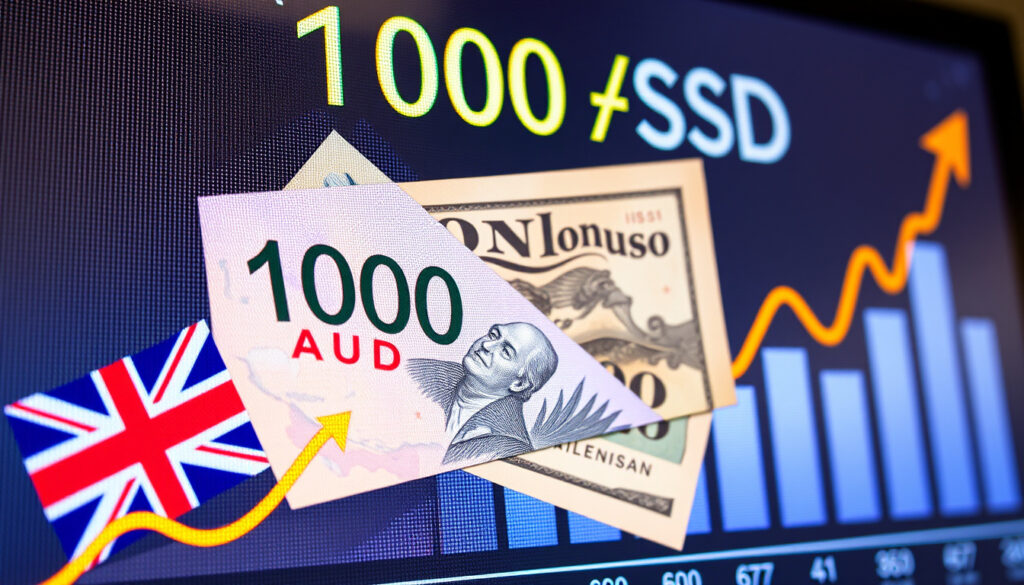
1000 AUD to USD – Current Rate, Trends and Forecast
As of April 15, 2026, converting 1,000 Australian dollars yields approximately 717.20 US dollars at the current spot rate of 0.7172 AUD/USD. Exchange rates fluctuate continuously throughout trading sessions, with recent quotes ranging between 0.6511 and 0.7190 across different financial platforms. This variability reflects market dynamics influenced by central bank policies, commodity markets, and global economic conditions.
The Australian dollar has demonstrated notable strength recently, gaining 12.59% against the US dollar over the past twelve months. The currency closed the previous trading day up 0.66%, building on a 1.42% monthly advance. For those tracking short-term movements, daily volatility has ranged from 0.03% to 0.79%, indicating moderate but consistent price action in this currency pair.
Traders and those planning currency exchanges should verify current quotes through their preferred financial platform before executing transactions. Mid-market rates, while useful for reference, exclude transfer fees and margins that providers apply to actual conversions.
1,000 AUD = 717.20 USD
+0.72%
0.7129 USD/AUD
0.6505 USD/AUD
Key Insights on AUD/USD Rate
The Australian dollar operates as a commodity currency, meaning its value correlates strongly with export commodities including iron ore, coal, and agricultural products. Rising commodity prices amid global demand have supported the currency’s 12.59% yearly gain, according to market analysis from Trading Economics.
- The Australian dollar has strengthened 12.59% against the US dollar over the past twelve months
- Central bank interest rate differentials currently favor the US dollar, with the Fed funds rate at 3.75% versus the RBA cash rate at 3.60%
- Recent AUD gains suggest shifting market expectations despite traditional interest rate disadvantages
- Global risk sentiment and commodity demand serve as primary volatility drivers
- Moderate daily volatility of 0.03% to 0.79% indicates relatively stable trading conditions
- The 6-month trading range spans from 0.6505 to 0.7056, showing an upward bias
AUD/USD Conversion Snapshot
| Metric | Value | Change |
|---|---|---|
| Spot Rate (AUD/USD) | 0.7172 | +0.66% (daily) |
| 1 AUD to USD | 0.7172 USD | +1.42% (monthly) |
| 1,000 AUD to USD | 717.20 USD | +12.59% (yearly) |
| 1-Year Average | 0.6830 | Nov 2025–Apr 2026 |
AUD vs USD: Current Strength and 1000 USD Equivalent
Understanding the relative strength between the Australian and US dollars requires examining both directions of the pair. At the current rate of 0.7172, each Australian dollar purchases approximately 0.72 US cents. Converting in the opposite direction, 1,000 US dollars yields roughly 1,533.60 Australian dollars, according to data from Revolut.
Comparing Currency Strength
The Australian dollar has historically traded above parity with the US dollar, reaching an all-time high of 1.49 in 1973. However, the current rate reflects a different era of monetary policy and economic conditions. The currency’s recent trajectory shows a strengthening trend, with the highest point in the past year reaching 0.7129 on March 12, 2026.
While the interest rate differential technically favors the US dollar, the Australian dollar has defied this traditional pressure. Market analysts point to commodity demand, trade balance improvements, and shifting risk sentiment as factors supporting AUD resilience. The discrepancy between interest rate fundamentals and actual market performance illustrates why currency markets require multifaceted analysis.
For practical purposes, those holding Australian dollars seeking US dollars should note that mid-market rates shown in conversion tables exclude provider fees. Actual amounts received when exchanging currency will typically be 0.5% to 3% less than the theoretical conversion depending on the service used. Australian residents planning retirement income considerations can reference the Age Pension Calculator – Estimate Rates Eligibility Australia for additional planning tools.
Conversion rates vary between providers due to different fee structures and spread margins. Checking multiple sources including Revolut, Xe, and Trading Economics helps identify the most competitive rates for your transaction.
AUD to USD Historical Rates and Chart
Examining the historical performance of the AUD/USD pair reveals patterns useful for contextualizing current levels. The six-month period from November 2025 through April 2026 shows an average rate of 0.6830, with a trading range between 0.6505 on November 30, 2025, and 0.7056 on February 28, 2026.
Recent Price Action
Daily closing prices through the period show initial weakness with quotes stabilizing around 0.65 before a significant rally pushed the pair to current levels near 0.7172. This trajectory represents a meaningful recovery from the lower boundary of the six-month range.
Interactive charting tools available through Xe, Revolut, and OFX allow users to visualize decade-long trends, identify historical peaks and troughs, and examine daily or monthly breakdowns. The all-time high of 1.49 recorded in 1973 occurred under vastly different global monetary conditions following the collapse of the Bretton Woods system.
For those requiring longer historical context, OFX and Wise provide access to over twenty years of exchange rate data, enabling analysis of multi-decadal trends and structural shifts in the Australian dollar’s value against its US counterpart.
Understanding Chart Patterns
Technical analysis of currency charts reveals the pair’s tendency toward sustained trends rather than mean-reversion patterns. The past twelve months demonstrate a consistent upward trajectory, with occasional pullbacks that have been followed by new highs. This behavior aligns with the fundamental drivers of commodity demand and shifting monetary policy expectations.
Some analytical platforms report limited historical metrics such as 30-day or 90-day highs and lows. The six-month data range provides adequate context for most practical assessments of current positioning.
Factors Affecting the AUD USD Exchange Rate
Multiple interconnected factors influence the AUD/USD exchange rate, creating a complex environment for currency analysis. Understanding these drivers helps explain rate movements and informs conversion timing decisions.
Central Bank Policy Divergence
The Reserve Bank of Australia maintains a cash rate of 3.60%, while the US Federal Reserve operates with a funds rate of 3.75%. This 15 basis point differential historically supports the US dollar through carry trade dynamics, where investors seeking higher returns convert funds into higher-yielding currencies. However, recent market behavior demonstrates that interest rate differentials alone do not determine exchange rate movements.
Forward guidance and anticipated policy changes often influence markets more significantly than current rate levels. Traders analyze Fed and RBA statements to anticipate future rate trajectories, with expectations sometimes overwhelming the mechanical effects of current rate differentials.
Commodity Market Influence
Australia’s status as a major exporter of iron ore, coal, and agricultural products establishes the Australian dollar’s classification as a commodity currency. Price movements in these export markets directly impact AUD valuation. When global demand for raw materials increases, as reflected in the recent 12.59% yearly appreciation, the Australian dollar tends to strengthen correspondingly.
This commodity linkage creates both opportunities and risks. Export revenue fluctuations affect the national income and trade balance, variables that feed into currency valuation models used by institutional investors and retail traders alike.
Broader Market Dynamics
Global risk sentiment significantly affects commodity currencies like the Australian dollar. During periods of risk appetite, capital flows toward higher-yielding assets including AUD-denominated investments. Conversely, risk-off environments typically strengthen traditional safe-haven currencies including the US dollar.
US economic indicators, trade balance data, and geopolitical developments also contribute to exchange rate volatility. The interplay between these factors creates the moderate but consistent daily movements ranging from 0.03% to 0.79% observed in recent trading.
How to Convert and Exchange AUD to USD
Converting Australian dollars to US dollars requires selecting an appropriate conversion method based on transaction size, timing requirements, and cost sensitivity. Multiple platforms offer this service with varying fee structures and exchange rate applications.
Available Conversion Tools
Digital currency converters provide immediate access to current rates and enable instant calculations. Revolut offers live rate updates alongside history graphs and in-app conversion functionality. Xe provides free interactive charts spanning up to ten years, useful for contextual analysis. For those requiring extended historical data, OFX and Wise maintain records exceeding twenty years at mid-market rates.
Banking platforms and dedicated forex providers like BankPro and MTFX Group offer additional conversion services with varying features. Trading Economics and Investing.com combine rate information with forecast data, news feeds, and detailed analytical tables suitable for informed decision-making.
- Revolut: Live rate updates with integrated conversion tools
- Xe: Interactive charting up to decade-long periods
- OFX and Wise: Extended historical data at competitive rates
- Trading Economics: Forecasts and comprehensive market analysis
- MTFX and BankPro: Real-time forex data and historical lookups
Mid-market rates shown in conversion tools represent wholesale prices unavailable to retail customers. Actual transactions include provider margins typically ranging from 0.5% to 3%. Verify total costs before completing currency exchanges.
Practical Exchange Considerations
Those planning currency conversions should compare total costs across providers rather than focusing solely on advertised rates. Wire transfers, credit card conversions, and cash transactions each carry distinct fee structures that affect effective exchange rates. For larger transactions, negotiating provider fees becomes possible, and dedicated forex services often offer more competitive rates than retail banking channels.
Timing decisions depend on individual urgency and market outlook. While forecasts suggest potential appreciation toward 0.73 over twelve months, short-term volatility means favorable rates may emerge at unexpected moments. Dollar-cost averaging, spreading conversions across multiple transactions, reduces timing risk for those with flexible scheduling flexibility. Those requiring assistance with other measurement conversions may find the 24 Inch to CM – Exact Conversion with Formula and Table resource helpful.
What’s Next for AUD/USD
Global macro models project the AUD/USD pair reaching approximately 0.71 by quarter-end and 0.73 within twelve months, according to Trading Economics forecasts. These predictions assume continued economic stabilization and sustained commodity demand supportive of Australian export revenues.
- Monitor upcoming Reserve Bank of Australia and Federal Reserve policy announcements for guidance shifts
- Track iron ore and coal price movements given their significant influence on AUD valuation
- Review US economic data releases including employment figures and inflation reports
- Assess global risk sentiment through equity market performance and volatility indices
Analysis: Why AUD/USD Fluctuates
Currency exchange rates reflect continuous negotiations between buyers and sellers across global forex markets. The AUD/USD pair specifically responds to divergent economic conditions, policy expectations, and capital flow dynamics between Australia and the United States.
The Australian economy’s heavy reliance on commodity exports creates direct linkages between sector performance and currency value. Meanwhile, the US dollar’s reserve currency status provides unique demand sources that interact differently with interest rate differentials than might occur between less prominent currency pairs.
For users converting currency for travel, business transactions, or investment purposes, understanding these fundamental drivers helps contextualize rate movements and informs more strategic conversion timing. Those with flexibility in when to exchange may benefit from monitoring trend directions rather than attempting to identify exact turning points.
Sources and Expert Analysis
“AUD, as a commodity currency, correlates with exports like iron ore and coal; rising commodity prices amid global demand support recent gains.”
— Market analysis from Trading Economics
Market data and analytical insights referenced in this article derive from multiple financial platforms including Revolut, Xe, Trading Economics, OFX, and Investing.com. Each source applies distinct methodologies for rate calculation, with variations reflecting different fee structures and data collection points.
The Reserve Bank of Australia publishes official exchange rate statistics through its website, while the Federal Reserve maintains current monetary policy information. Treasury.gov provides additional context on US interest rate dynamics affecting currency valuation.
Summary
Converting 1,000 Australian dollars to US dollars yields approximately 717.20 USD at the current rate of 0.7172 as of mid-April 2026. The Australian dollar has strengthened 12.59% against its US counterpart over the past twelve months, with recent momentum showing continued appreciation despite interest rate differentials favoring the dollar. Conversion tools from Revolut, Xe, and other platforms provide accessible rate information, though actual transactions include provider fees that affect final amounts received.
Frequently Asked Questions
How much is 1000 USD in AUD?
At the current exchange rate of 0.7172, converting 1,000 US dollars yields approximately 1,533.60 Australian dollars.
What is the AUD USD forecast?
Global macro models predict AUD/USD reaching approximately 0.71 by quarter-end and 0.73 within twelve months, driven by anticipated economic stabilization.
Where can I find live AUD to USD rates?
Live rates are available through Revolut, Xe, Trading Economics, and other financial platforms that update continuously throughout trading sessions.
Is the Australian dollar stronger than the US dollar?
The Australian dollar has strengthened 12.59% against the US dollar over the past twelve months, though it currently trades below parity at 0.7172.
What affects the AUD to USD exchange rate?
Primary factors include central bank policy decisions, commodity prices especially iron ore and coal, interest rate differentials, global risk sentiment, and US economic indicators.
How accurate are currency conversion tools?
Conversion tools display mid-market rates reflecting interbank wholesale prices. Actual transactions include provider margins of 0.5% to 3%, resulting in slightly lower amounts received.
What was the AUD USD all-time high?
The Australian dollar reached its all-time high of 1.49 against the US dollar in 1973, following the collapse of the Bretton Woods international monetary system.
More related posts
 Brigitte Bardot: Death, Family Estrangement, and Legacy
 Adam Treloar: Injury, Retirement, Partner & Salary Update
 Aussie Broadband Login: How to Access MyAussie, Webmail & App
 Anna Kalinskaya: Ranking, Relationship With Jannik Sinner & Net Worth
 Matt Walsh: Religion, Wife, Career – Facts & Biography
 Mt Baw Baw Guide: Skiing, Snow Play, and Comparisons
 Sam Mac: What Happened to the Sunrise Weather Presenter
 Kristin Cabot: Coldplay Kiss Cam, Husband, Divorce & Aftermath
