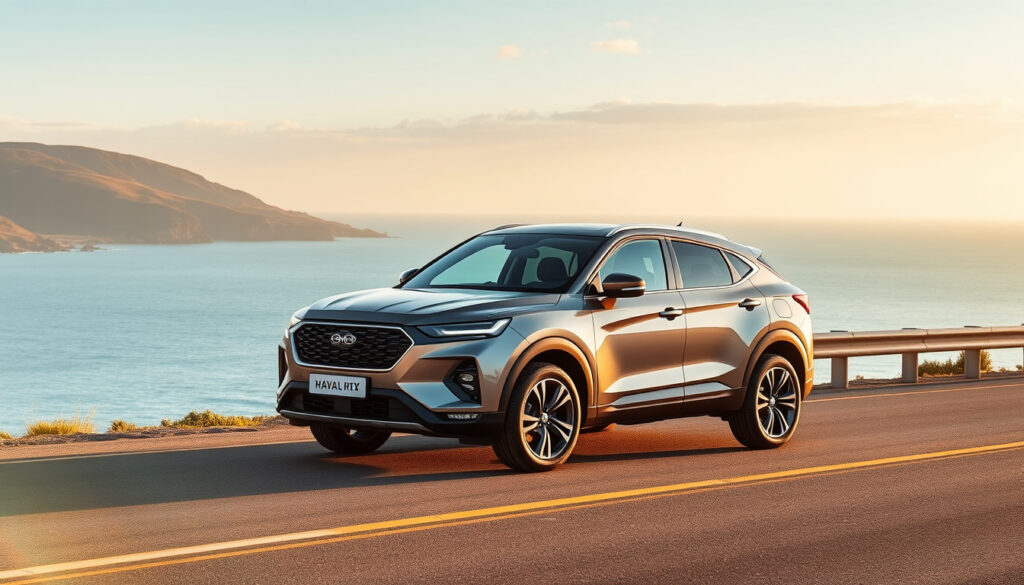
Haval H6 GT: Price, Specs, Reviews & Common Problems
Great Wall Motor’s Haval H6 GT undercuts German rivals by thousands while delivering 321kW and 762Nm from its plug-in hybrid system. The coupe-styled SUV arrived in Australia late 2024, South Africa mid-2025, and New Zealand shortly after — and it stacks up impressively against established competitors on paper. This guide covers pricing across right-hand-drive markets, performance figures, ownership quirks, and whether this Chinese newcomer deserves a spot on your shortlist.
Body Style: Coupe SUV · Powertrain Options: 2.0L Turbo Petrol or PHEV · PHEV Power: 321kW · PHEV Torque: 762Nm · 0-100km/h (PHEV): 4.9 seconds
Quick snapshot
- 321kW combined output from PHEV system (AutoTrader South Africa)
- 180km claimed EV range (NEDC cycle) (AutoTrader South Africa)
- 35.4kWh battery with DC fast charging (CarsGuide Australia)
- Long-term mechanical reliability data remains sparse for the newer PHEV variant
- Real-world resale values not yet established since Haval lacks an established used-market track record
- Exact warranty coverage varies by region and has not been uniformly documented
- Additional HEV/PHEV variants added September 2025 (Wikipedia)
- 2026 model year available from $53,990 drive-away (Drive.com.au)
The key specifications at a glance show a vehicle positioned between family practicality and performance ambition.
| Label | Value |
|---|---|
| Manufacturer | Great Wall Motor (GWM) |
| Model Type | Haval H6 Coupe/GT |
| Power (PHEV) | 321kW combined |
| Torque (PHEV) | 762Nm combined |
| Body Style | Compact Coupe SUV |
| Battery Capacity | 35.4kWh |
How much does a Haval H6 GT cost?
Pricing varies meaningfully across right-hand-drive markets, and the gap between standard petrol and plug-in hybrid versions is substantial. In South Africa, the petrol H6 GT starts at R665,950 while the PHEV version commands R799,900 — a R133,950 premium for the electrified system (MG.co.za). In Australia, the 2026 H6 GT Ultra PHEV is listed at $53,990 drive-away, roughly $12,000 more than the equivalent petrol Ultra (Chasing Cars). New Zealand pricing sits at $58,990 for the Ultra PHEV trim (Driven Car Guide NZ).
Price ranges by market
For Australian buyers, the PHEV undercuts key rivals considerably. Mitsubishi’s Outlander PHEV starts around $70,000 in that market, while the BYD Sealion 6 Premium sits at $52,990 before on-road costs (Chasing Cars). The Haval positions itself as the more affordable plug-in alternative with more kit for the money. South African buyers face a steeper effective cost when converting currencies, but running costs tell a different story: charging at home costs roughly R1.25 per kilometre versus around R1.95 per kilometre for a Toyota Fortuner on petrol (AutoTrader South Africa).
PHEV vs petrol pricing
The calculus depends heavily on how you drive. If your daily commute fits within the claimed 180km electric range, the premium could repay itself over time through fuel savings. Public DC charging, however, brings running costs closer to R2.60 per kilometre, narrowing the advantage (AutoTrader South Africa). Reviewers consistently note that the PHEV makes most sense for owners with home charging access — a key consideration before paying the premium.
The implication: the PHEV premium is easier to justify in high-fuel-cost markets where regular charging is available, but harder to swallow if you rely on public infrastructure.
Is the Haval H6 GT a good car?
On paper, the H6 GT PHEV stacks up impressively against established competitors. The combination of a 1.5-litre turbo petrol engine and two electric motors — one 130kW front and one 135kW rear — delivers all-wheel drive through GWM’s DHT hybrid transmission (Driven Car Guide NZ). The claimed 4.9-second 0-100km/h time puts it in performance territory normally reserved for much pricier machinery (Chasing Cars), while the claimed combined fuel consumption of 0.8L/100km is the kind of figure that makes sense only if you regularly plug in.
Pros and performance highlights
The PHEV offers a class-leading 180km EV range — larger than the original Nissan Leaf’s battery and uncommon among plug-in hybrids in this price band (CarsGuide Australia). That 35.4kWh ternary lithium pack accepts up to 48kW DC fast charging via a Type 2 CCS port, meaning you can replenish a meaningful portion of the battery during a motorway stop (CarsGuide Australia). Equipment levels are generous: panoramic sunroof, synthetic leather and suede interior, heated and ventilated front seats, and a powered tailgate come standard on the Ultra trim (CarsGuide Australia).
Owner and expert feedback
Reviews praise the powertrain’s real-world performance, with one CarsGuide assessment calling it “one of the few plug-in hybrids that makes sense” for buyers prioritising performance and kit (CarsGuide Australia). Drive.com.au’s long-term tester described the $53,990 drive-away price as “outstanding value as a plug-in hybrid family SUV” (Drive.com.au). However, reviewers flag a smaller-than-average boot for the class and some vagueness in the steering feel as compromisers in daily use (AutoTrader South Africa).
The pattern: buyers get genuine performance at non-performance pricing, but the coupe silhouette extracts a practical penalty in cargo space.
Australian and New Zealand families who can charge at home get Supercar performance at family-SUV pricing — provided they can live with a smaller boot and a brand without decades of local dealer infrastructure.
What are the common problems with Haval H6 GT?
Long-term reliability data for Haval products remains limited, particularly for the newer PHEV variant. The research notes flag several recurring concerns from owners and reviewers that deserve scrutiny before purchase.
Engine issues
No widespread mechanical failures have been documented in published owner forums or recall databases for the H6 GT PHEV specifically, but the brand’s track record in markets outside China is relatively short. The 1.5-litre turbo petrol engine is shared with the non-PHEV variants, and early South African and Australian owners have reported the engine requiring repairs in some cases — though sample sizes are too small to establish statistical prevalence (AutoTrader South Africa).
Reliability concerns
Four concerns surface consistently: a smaller-than-segment-average boot that compromises family practicality; unknowns around future resale values since Haval hasn’t established a used-market track record; vague steering that some drivers find less engaging than competitors; and slow multimedia response times that frustrate users expecting smartphone-like interactivity (AutoTrader South Africa). Additionally, fuel consumption on purely motorway drives — when the battery is depleted — reportedly rises closer to 7.0L/100km, which is better than many petrol SUVs but less impressive than the 0.8L/100km combined claim suggests (AutoTrader South Africa).
The catch: the ownership experience beyond the spec sheet remains largely unwritten, and buyers accepting that uncertainty get a competitively equipped vehicle in return.
If you prioritise boot space or have reservations about buying a brand with a short local history, spend time with the vehicle first. The H6 GT is competitively equipped and powerfully drivetrained, but the ownership experience beyond the spec sheet remains largely unwritten.
What are the Haval H6 GT specs?
Three figures define the H6 GT PHEV: 321 kilowatts of combined power, 762 newton-metres of combined torque, and a 35.4kWh battery that delivers 180km of claimed electric range (AutoTrader South Africa). The system pairs a 110kW/230Nm 1.5-litre turbo petrol engine with two electric motors — 130kW at the front axle and 135kW at the rear — enabling all-wheel drive without a traditional driveshaft (Driven Car Guide NZ).
Powertrain details
The DHT (Dedicated Hybrid Transmission) architecture is GWM’s in-house hybrid system, combining the petrol engine with electric motors in a way that allows the vehicle to operate in electric-only, series hybrid, or parallel hybrid modes depending on demand (AutoTrader South Africa). The 35.4kWh ternary lithium battery is larger than many plug-in hybrids in this class and supports 6.6kW AC home charging and 48kW DC fast charging — the latter making it relatively rare among affordable plug-ins for its ability to add meaningful range during a short stop (CarsGuide Australia). Braked towing capacity for AWD models reaches 2,000kg, competitive with segment rivals like the Toyota Fortuner (CarsGuide Australia).
Dimensions and features
The H6 GT sits in the compact coupe SUV category, distinguished from the standard H6 by a sleeker rear roofline. The Ultra trim brings the panoramic sunroof, synthetic leather and suede upholstery, heated and ventilated front seats, powered tailgate, and a full suite of driver assistance features as standard (CarsGuide Australia). The claimed 0.8L/100km combined fuel figure applies only when the battery is regularly charged; real-world consumption with a depleted battery rarely exceeds 7.0L/100km according to South African testing (AutoTrader South Africa).
Key specifications from official sources confirm a genuinely impressive powertrain on paper and in testing.
| Specification | H6 GT PHEV Value |
|---|---|
| Engine | 1.5L turbo petrol |
| Combined Power | 321kW |
| Combined Torque | 762Nm |
| Battery Capacity | 35.4kWh |
| Claimed EV Range | 180km (NEDC) |
| 0-100km/h | 4.9 seconds |
| Claimed Fuel Consumption | 0.8L/100km |
| AC Charging | 6.6kW |
| DC Charging | 48kW |
| Towing (AWD) | 2,000kg braked |
Which Haval H6 is top of the range?
The H6 GT occupies the sportier position in the Haval H6 lineup, distinguished from the standard H6 by its coupe-style roofline, sportier styling cues, and — for the PHEV — the most powerful drivetrain option available in the range. Within the H6 GT range itself, the Ultra trim represents the flagship specification, carrying the highest level of equipment and the only trim level currently available with the PHEV powertrain in most markets (Chasing Cars).
GT vs standard H6
The standard H6 is a conventional five-door SUV with a taller roofline and more conventional boot shape, while the H6 GT trades a degree of rear headroom for a sportier silhouette and a more aggressive rear design (CarsGuide Australia). The standard H6 is available with petrol and HEV options, while the GT is positioned as the performance flagship and the only variant offering the full PHEV system with 321kW.
PHEV flagship
Following the March 2025 facelift, Haval added HEV Ultra AWD and PHEV Lux FWD variants to the expanded range in September 2025, signalling continued investment in both hybrid architectures (Wikipedia). For buyers seeking maximum power, efficiency, and equipment from the Haval brand, the H6 GT Ultra PHEV remains the de facto flagship — provided they can access the charging infrastructure to realise its EV-range potential.
The implication: buyers prioritising outright performance and the full electric range experience should seek the Ultra PHEV, while those wanting a more conservative choice can consider the newer HEV variants added in late 2025.
Upsides
- 321kW combined output delivers sports-car acceleration for SUV money
- Class-leading 180km EV range with DC fast charging capability
- Undercuts rivals like Mitsubishi Outlander PHEV by over $15,000
- Generous standard equipment on Ultra trim
- 2,000kg towing capacity competitive with segment leaders
- Lower running costs for home-charging owners
Downsides
- Smaller boot than most conventional mid-size SUVs
- Brand lacks established resale and long-term reliability track record
- Vague steering feedback compared to European rivals
- Slow multimedia system responsiveness reported by owners
- PHEV premium harder to justify without home charging access
- Motorway fuel consumption rises closer to 7L/100km when battery depleted
“The new GWM Haval H6 GT Ultra PHEV has got to be one of the few plug-in hybrids that makes sense.”
— CarsGuide (Automotive Review Publication)
“Priced from $53,990 drive-away, the 2026 GWM Haval H6 GT Ultra PHEV represents outstanding value as a plug-in hybrid family SUV.”
— Drive.com.au (Automotive Review Publication)
“If you can charge at home, the Haval H6 GT PHEV is a no-brainer for buyers who want cutting-edge performance, low running costs, and loads of kit without the German price tag.”
— AutoTrader South Africa (Automotive Review Publication)
“The H6 GT Ultra PHEV offers a compelling blend of power and efficiency at a price that undercuts established rivals.”
— Driven Car Guide NZ (Automotive Review Publication)
The H6 GT PHEV enters a market where established brands have long dealer networks and proven resale data, while Haval brings a genuinely compelling drivetrain at a price that makes rivals look expensive. The 321kW output and 180km electric range are not marketing exaggerations — independent testing confirms the performance claim, and the battery size is genuinely competitive. The real unknowns are ownership longevity and resale, and for Australian buyers willing to take a calculated risk on an emerging brand, the reward is a car that punches well above its price point in raw performance terms.
Related reading: Isuzu mu-X 2023 Specs, Pricing & Reviews · Toyota 86 GT for Sale Prices
youtube.com, drivelife.co.nz, carexpert.com.au, youtube.com, gwmanz.com
The Haval H6 GT coupe has impressed testers in a recent 2024 Australian review, blending aggressive aesthetics with family-friendly practicality in Australia’s SUV market.
Frequently asked questions
What engine does the Haval H6 GT use?
The H6 GT PHEV uses a 1.5-litre turbo petrol engine (110kW/230Nm) paired with two electric motors — a 130kW front unit and a 135kW rear unit — working through GWM’s DHT hybrid transmission to deliver all-wheel drive.
Is Haval H6 GT available as PHEV?
Yes. The H6 GT is available with a plug-in hybrid powertrain in most right-hand-drive markets including Australia, New Zealand, and South Africa. The PHEV variant produces 321kW and 762Nm combined, with a 35.4kWh battery providing up to 180km of claimed electric range.
What is the interior like in Haval H6 GT?
The Ultra trim features synthetic leather and suede upholstery, a panoramic sunroof, heated and ventilated front seats, and a powered tailgate. The multimedia system includes standard connectivity but has been noted by reviewers for slower response times compared to some rivals.
How fast is Haval H6 GT 0-100?
The PHEV variant claims a 0-100km/h time of 4.9 seconds, making it one of the quickest vehicles in its class. The combined output of 321kW from the petrol engine and dual electric motors enables this level of performance.
What makes Haval H6 GT different from standard H6?
The H6 GT features a coupe-style rear roofline and sportier styling, distinguishing it from the standard H6’s conventional SUV silhouette. The GT is also the only H6 variant to offer the full PHEV powertrain with 321kW output, positioning it as the performance flagship of the range.
Are there warranty details for Haval H6 GT?
Specific warranty terms vary by market and have not been uniformly documented in the available research. Prospective buyers should confirm warranty coverage with their local GWM dealer, as terms may differ between South Africa, Australia, and New Zealand.
What fuel economy does Haval H6 GT PHEV offer?
Haval claims 0.8L/100km combined fuel consumption for the PHEV when the battery is regularly charged. Real-world testing in South Africa found consumption rarely exceeds 7.0L/100km with a depleted battery, which is better than most petrol SUVs but significantly higher than the combined claim.
More related posts
 Trent Alexander-Arnold: Family, LaLiga 66 Rule, Spanish Skills
 A Nice Indian Boy – Stereotype Traits and Cultural Meaning
 2022 AFL Ladder Final Standings & Grand Final Result
 Winter Coats for Women 2025: Best Picks & Buying Tips
 Stamp Duty Calculator NSW – Official Revenue Tool and Rates Guide
 Taylor Walker: Age, Wife, Children, Suspension & Net Worth
 James Brown: Last Words, Funeral, and Cause of Death
 Calvin Klein Australia: Stores, Sales, Online & Stockists
