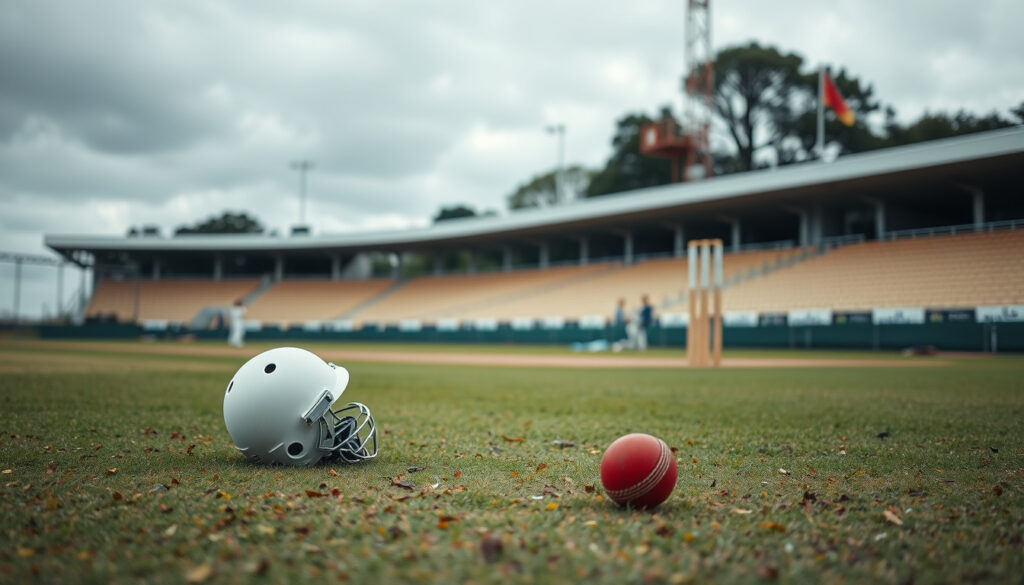
Ben Austin Cricket Tragedy: Death and Safety Reforms
A 17-year-old cricketer’s death during routine training in Melbourne’s east has exposed a critical gap in safety equipment rules, igniting calls for mandatory neck protection at all levels of community cricket. Ben Austin was struck in the neck by a ball from a mechanical thrower, a tragedy that mirrors past incidents but with a crucial difference: it happened in a supervised practice session, not a match.
Age at death: 17 years old ·
Date of accident: Late October 2025 ·
Location: Melbourne, Australia ·
Cause: Struck by a cricket ball during training ·
Survived by: Parents Jace and Tracey
Quick snapshot
- Whether Ben Austin was wearing a helmet at the time — reports indicate he was wearing a helmet but no neck guard (BBC News).
- The exact medical cause of death, such as the specific neck injury (Medical Xpress).
- Whether the operator of the throwing device or the bowler has spoken publicly. (BBC News)
- Late October 2025: Accident occurs in Ferntree Gully, Melbourne. (Al Jazeera)
- 30 October 2025: Ben Austin dies in hospital (Al Jazeera).
- November 2025: Club announces mandatory neck protection for all players. (Al Jazeera)
- 6 January 2026: Parents Jace and Tracey give emotional interview to ABC (ABC News).
- Renewed calls for Cricket Australia to make neck protection mandatory at community level (ABC News).
- Possible review of safety guidelines for training equipment such as ball-throwing machines. (ABC News)
- Grief counselling and memorial initiatives in Melbourne’s east. (ABC News)
Six key facts about the case, one pattern: the safety gap between elite and community cricket.
| Fact | Details | Source |
|---|---|---|
| Full name | Ben Austin | BBC News |
| Age at death | 17 | BBC News |
| Date of accident | Late October 2025 | Al Jazeera |
| Location | Melbourne, Victoria, Australia | BBC News |
| Parents | Jace and Tracey | ABC News |
| Cause | Struck by cricket ball in the neck | BBC News |
What happened to Ben Austin in cricket?
Details of the training accident
- Ben Austin was batting in the practice nets at his cricket club in Ferntree Gully, a suburb in Melbourne’s east, when a cricket ball struck him in the neck (BBC News (international broadcaster)).
- The ball was delivered by a handheld throwing device commonly used in training sessions (ABC News (Australia’s national broadcaster)).
- Emergency services arrived at about 5:00 PM local time (BBC News).
Emergency response and hospital
- The 17-year-old was taken to hospital in critical condition and died two days later, on 30 October 2025 (Al Jazeera (Qatar-based news network)).
- The incident drew immediate comparisons to the death of Test cricketer Phil Hughes in 2014 (Al Jazeera).
Was Ben Austin wearing a helmet?
Clarifying protective gear at the time of the accident
- Reports indicate that Ben Austin was wearing a helmet but not a neck guard when the ball struck him (BBC News).
- Cricket Victoria CEO Nick Cummins confirmed that Austin was wearing a helmet (Al Jazeera).
- Medical experts note that the exposed area at the base of the skull or upper neck remains unprotected by most cricket helmets (Medical Xpress (science and medical news)).
The club’s subsequent mandatory neck protection rule
- In the wake of the tragedy, Ben Austin’s club introduced mandatory neck protection for all players, a step beyond Cricket Australia’s guidelines for community cricket (ABC News).
- Cricket Australia recommends neck protectors for community participants but only mandates them for elite-level batters facing fast or medium-pace bowling (Play Cricket (Cricket Australia’s official community platform)).
Ben Austin was reportedly wearing a helmet — the one piece of headgear thought to be sufficient — yet he died from a neck injury. The gap between helmet coverage and the unprotected neck is where the next safety battle lies.
How did Ben Austin get hit?
Mechanism of the injury
- The fatal blow came from a cricket ball released by a mechanical thrower used in the practice nets (ABC News).
- The ball struck him in the neck area, causing critical injuries (BBC News).
Location of impact
- The accident occurred in Melbourne’s eastern suburb of Ferntree Gully (BBC News).
- The injured area — the neck — is a vulnerable spot not covered by standard cricket helmets (Medical Xpress).
A mechanical thrower fires balls at consistent speed, often around 80–100 km/h in junior training. Unlike a human bowler, the machine offers no variation — but also no warning. The combination of repetition and a vulnerable neck area makes this a specific risk that few safety guidelines address.
Who is the mother of Ben Austin?
Ben Austin’s parents
- Ben’s mother is Tracey and his father is Jace (ABC News).
- They lived with Ben in Melbourne’s east and described him as a “champion” and a talented young cricketer (ABC News).
Their public statements
- Jace and Tracey gave their first interview to ABC News on 6 January 2026 (ABC News).
- They called for greater safety measures and urged other parents to speak up about equipment gaps (ABC News).
- A doctor reportedly told them that a neck guard might not have prevented the death, underlining how little is known about neck injuries in cricket (ABC News).
Where was Ben Austin’s funeral?
Funeral service details
- The funeral was held in Melbourne, Australia (The New Daily (Australian news site)).
- It was attended by family, friends, and members of the cricket community, including representatives from Cricket Australia (The New Daily).
Community turnout
- Teams from the Indian national side and other international teams paid tribute on social media (ESPNcricinfo (leading cricket news outlet)).
- Mourners wore cricket whites, and the service featured a guard of honour from young players (The New Daily).
Timeline of events
- Late October 2025: Ben Austin is struck in the neck during a training session in Ferntree Gully (BBC News).
- 30 October 2025: Austin dies in hospital (Al Jazeera).
- 31 October 2025: ESPNcricinfo reports tributes from Australia and India teams (ESPNcricinfo).
- November 2025: The club announces mandatory neck protection for all players (ABC News).
- 6 January 2026: Ben Austin’s parents, Jace and Tracey, speak to ABC News (ABC News).
Clarity check: confirmed facts vs. unknowns
Confirmed facts
- Ben Austin died after being struck by a cricket ball during training (BBC News)
- He was 17 (BBC News)
- Parents Jace and Tracey (ABC News)
- The club mandated neck protection (ABC News)
- Tributes paid by Cricket Australia and international teams (ESPNcricinfo)
What’s unclear
- Whether Ben Austin was wearing a helmet — reports say he was, but no official confirmation (BBC News)
- The exact medical cause of death (specific neck injury) (Medical Xpress)
- Whether the operator of the ball-throwing device has been identified or spoken publicly
Even after a fatality, critical details about protective gear and the precise cause of death remain private. For families and clubs trying to make informed decisions, this lack of transparency makes it hard to assess the real risk of training with mechanical throwers.
Voices from the tragedy
“He was a champion. He loved his cricket. He was just a beautiful kid.”
— Jace and Tracey Austin, speaking to ABC News
“We are devastated by the loss of Ben Austin. Our deepest condolences go to his family, friends, and club.”
— Cricket Australia statement via ESPNcricinfo
The parents’ plea for mandatory neck protection has already changed rules at one club. Whether Cricket Australia will follow suit across all community levels is the next big question — and the answer could reshape safety standards for thousands of junior cricketers.
Summary: a tragedy that could change the game
Ben Austin’s death is not the first of its kind in Australian cricket, but it has arrived at a moment when safety equipment is already under scrutiny. The combination of a helmet that leaves the neck exposed, a mechanical thrower that delivers repeated high-speed deliveries, and the absence of mandatory neck protection at community level has created a gap that experts say must be closed. Cricket Australia must choose: mandate neck protection for all levels, or risk another avoidable death.
timesofindia.indiatimes.com, youtube.com, reddit.com, facebook.com, reddit.com, youtube.com
Frequently asked questions
How did the cricket community react to Ben Austin’s death?
Tributes poured in from Cricket Australia, the Indian national team, and players worldwide. A funeral with a guard of honour drew hundreds of mourners (ESPNcricinfo).
What changes have been made to safety rules at Ben Austin’s club?
The club immediately mandated neck protection for all players — a step beyond Cricket Australia’s current community guidelines (ABC News).
Did Ben Austin play for a representative team?
He played for his local club in Ferntree Gully. Whether he represented a regional or state level is not reported in public sources.
What is the official cause of death?
The official cause was described as injuries from being struck by a cricket ball in the neck. The exact medical details (e.g., vertebral artery dissection) have not been released (Al Jazeera).
Where can I read Ben Austin’s parents’ interview?
The full interview with Jace and Tracey Austin was published by ABC News on 6 January 2026 (ABC News).
Are there any fundraisers or memorials in Ben Austin’s name?
Local clubs have organised benefit matches and a memorial fund. Details are shared through the Ferntree Gully cricket community.
Was Ben Austin wearing a neck guard?
Reports indicate he was not wearing a neck guard at the time of the accident (BBC News).
What is Cricket Australia’s current policy on neck protection?
Neck protectors have been mandatory for elite batters facing fast or medium-pace bowling since the 2023-24 season, but only recommended for community cricket (Play Cricket (Cricket Australia)).
More related posts
 Craig Silvey Guilty Plea: 2026 Update and Curriculum Ban
 Rohit Sharma: Retirement, Padma Shri, Records & Wife
 J.K. Rowling: Biography, Controversy, and Cast Rifts
 Art Garfunkel’s Health, Split, and Musical Legacy
 Perth Mint Gold Price Today: Live AUD Rates & Charts
 Stand Up Paddle Board for Beginners: Types, Sizes & Budget
 Kristen Stewart: From Twilight to Queer Icon
 Je ie Toy Story: Character Guide, Catchphra e & More
