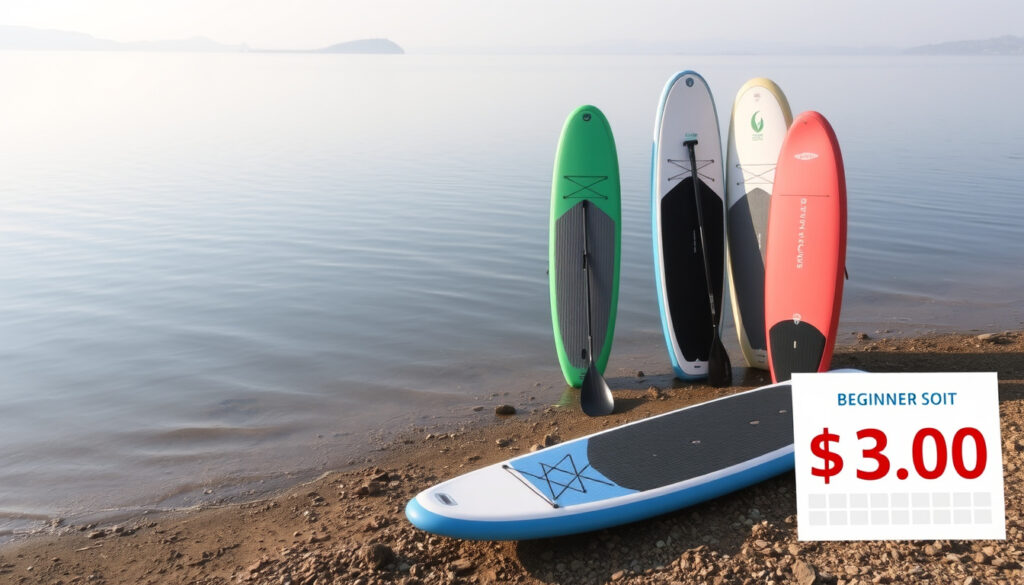
Stand Up Paddle Board for Beginners: Types, Sizes & Budget
The first time you stand on a paddle board and feel the water shift beneath your feet, the learning curve shrinks to one simple question: why didn’t you try this sooner? For beginners, the real challenge isn’t balance—it’s choosing the right board from a market full of options.
Average beginner board length: 10–11 ft · Weight capacity (10 ft board): ~200–250 lbs · Inflation time (inflatable): 5–8 minutes · Price range for quality inflatable: €400–€800 · Most popular board type in Ireland: Inflatable SUP · Lidl paddle board typical price: €299 (based on past offers)
Quick snapshot
- Portable and easy to store (REI Expert Advice)
- Good for beginners (GearJunkie)
- Lower maintenance (REI Expert Advice)
- Price: €300–€800 (REI Expert Advice)
- Better glide and performance (REI Expert Advice)
- Requires roof rack or storage space (REI Expert Advice)
- More durable in rough conditions (REI Expert Advice)
- Price: €500–€1500 (REI Expert Advice)
- Designed for longer distances
- Narrower and faster
- Requires intermediate skills
- Length: 12–14 ft
- Versatile for flatwater and small surf (Outdoor Gear Lab)
- Good for yoga and fishing (Outdoor Gear Lab)
- Beginner-friendly (Outdoor Gear Lab)
- Length: 10–11 ft (Outdoor Gear Lab)
The table below distills the essentials for first-time buyers.
| Specification | Value |
|---|---|
| Suitable for beginners | All-around and inflatable boards |
| Price range (beginner) | €300–€600 |
| Popular length | 10–11 ft |
| Inflation time | 5–10 minutes |
| Weight capacity (10ft) | 200–250 lbs |
| Top Irish spot | Dun Laoghaire Harbour |
What type of paddle board is best for beginners?
What size paddle board should a beginner choose?
- Length between 10 and 11 feet suits most adults starting out, according to REI’s expert advice on paddle boards.
- Width of 32 to 34 inches provides the stability new paddlers need to build confidence without feeling unstable.
- Volume matters too: boards in the 180–250 litre range keep heavier riders above the waterline without sacrificing manoeuvrability.
A 10-foot board at 33 inches wide is the sweet spot for most Irish beginners — long enough to track in a straight line across a harbour, wide enough to handle the wobble of a first stand. GearJunkie’s 2026 SUP guide notes that inflatable models make natural first boards because they combine durability with easy storage.
The implication: starting with the right dimensions cuts the learning curve dramatically, which matters more than chasing marginal performance gains.
Stability and width considerations for new SUPers
- A board 32 inches wide or more feels noticeably steadier underfoot than a narrower touring shape.
- Thicker rails (the edges of the board) add secondary stability once you lean into a turn.
- Inflatable boards have a softer, more forgiving surface that makes falls less jarring — REI notes this is a major reason they work well for beginners and SUP yoga.
Width is the single most forgiving dimension on a paddle board. A 34-inch board lets a new paddler stand with feet shoulder-width apart without feeling the edges tilt. That extra margin matters more in choppy Irish conditions than it would on a flat lake.
A wide, stable board is slower and less efficient to paddle over distance. Beginners trading speed for confidence are making the right call — you can always buy a narrower board once your balance catches up.
Are inflatable paddle boards worth buying?
Pros and cons of inflatable and solid boards
- Inflatable boards pack into a backpack and fit in a small flat or car boot — no roof rack needed (REI’s guide on inflatable SUP benefits).
- Hard boards deliver better glide and speed because the rigid hull transfers each paddle stroke directly into forward motion (REI’s comparison of board types).
- Setup for an inflatable takes 5 to 10 minutes with the included pump (Green Water Sports’ inflatable vs hard breakdown).
- Solid boards are grab-and-go: zero setup time.
The choice between inflatable and hard is really about where you live and how you’ll get to the water. For anyone in an apartment, terraced house, or without a car with roof bars, the inflatable removes the biggest barrier to entry — storage and transport. Hard boards perform better on the water, but only if you can actually get them there.
An inflatable board that stays at home because it’s easy to store gets used more than a hard board that’s a hassle to move. For Irish beginners, convenience often trumps pure performance.
What this means: the board that fits your life will get you on the water more often, which is the real measure of value.
Durability and performance comparison
- Modern inflatables use drop-stitch PVC construction that resists punctures and impacts. GearJunkie’s 2026 roundup describes inflatable boards as “very durable” and notes they pack down small.
- Hard boards can dent, crack, or delaminate if dropped or struck against rocks, though they handle rough coastal landings better than inflatables.
- Performance gap narrows each year: Green Water Sports claims modern 2026 inflatables are 20% lighter and nearly as stiff as carbon boards (a claim that remains unverified by independent lab tests).
The pattern: material science has made inflatables a legitimate choice for all but competitive paddlers.
Is the Lidl paddle board good?
Lidl paddle board price and value
- The Lidl paddle board is an inflatable model that has appeared in seasonal offers around €299.
- It includes a paddle, pump, backpack, and removable fin — everything needed to hit the water on day one.
- Construction uses standard drop-stitch PVC with a single-layer rail, which is adequate for flatwater but less rigid than premium multi-layer boards.
At roughly half the price of a mid-range inflatable from a dedicated SUP brand, the Lidl board opens up stand up paddle boarding to households that would never spend €600 on a hobby they haven’t tried yet. The trade-off is lower rigidity and a less efficient shape, which means you’ll work harder to cover distance.
How it compares to other budget boards
- Decathlon’s entry-level inflatable SUP, the Itiwit X100, typically sells for €350 and includes similar accessories with slightly better rail construction.
- The Lidl board lacks the reinforced side rails that higher-end boards use to improve tracking and stiffness.
- For casual paddling on calm harbours and lakes — exactly where most Irish beginners start — the Lidl board delivers adequate performance.
A Lidl board that sees heavy use over two seasons may lose rigidity and begin to feel “spongy” underfoot. Serious paddlers will outgrow it quickly. Casual users who paddle a few times a year will find it perfectly fit for purpose.
Implication: for the price, it’s a low-risk entry point, but plan to upgrade if your hobby turns into a habit.
What is the best budget paddle board?
Key features to look for on a budget board
- Included accessories: a three-piece paddle, a dual-action pump, a backpack, and a removable fin are the minimum. Avoid boards that sell these separately.
- Drop-stitch construction with at least one reinforced layer on the rails for durability.
- A stated weight capacity that covers your body weight plus basic gear — most 10-foot budget boards handle 200–250 pounds.
Budget boards in the €200–€400 range often cut corners on the paddle (heavy plastic blades) and the pump (slow, single-action cylinders). Factor in €30–€50 for a better paddle if you plan to paddle more than once a month.
The cheapest boards sometimes use lower-grade PVC that degrades faster under UV exposure. Store your budget board out of direct sunlight and it will last noticeably longer than one left on a sunny balcony.
The takeaway: a little extra care extends the life of a budget board significantly.
Top budget boards available in Ireland
- Lidl Crivit SUP (~€299 seasonal): Best value for absolute beginners on a tight budget. Available in limited quantities during summer promotions.
- Decathlon Itiwit X100 (~€350): Slightly more rigid than the Lidl board, with a better pump and paddle included. Widely available year-round.
- Aqua Marina Vapor (~€380): A dedicated entry-level brand with multi-layer drop-stitch construction and a tracked shape that glides better than flat-bottom boards.
The pattern: a small price increase from the cheapest tier buys noticeably better build quality and accessories.
Is a 10ft or 11ft paddle board better?
When is a 12ft board too big?
- Longer boards (11 feet and up) track straighter and glide more efficiently between strokes (REI’s sizing guidance).
- A 12-foot board is typically designed for touring or racing. It’s harder to turn, heavier to carry, and less stable for a beginner who hasn’t mastered pivot turns.
- For recreational paddling on Irish lakes and sheltered harbours, 12 feet is more length than most beginners need or want.
The rule of thumb: add 2 to 3 feet to your height and that’s a comfortable board length. For a 5’10” paddler, a 9- or 10-foot board works well. For someone 6’2″ or taller, 11 feet starts to feel like the right fit.
Can a 10ft board hold two people?
- A 10-foot board can physically carry two small adults on flatwater, but stability drops sharply and the board sits low in the water.
- Most 10-foot boards are rated for a single paddler up to around 220–250 pounds. Exceeding that reduces manoeuvrability and increases the risk of tipping.
- For tandem paddling, a board 12 feet or longer with a width above 34 inches is the safer choice.
Two people on a 10-foot board is a novelty, not a practical arrangement. If you regularly want to paddle with a partner or child on the same board, buy a dedicated tandem board or two separate inflatables.
Five board categories, one pattern: each extra foot of length improves glide but reduces manoeuvrability, and extra width adds stability at the cost of speed. Beginners in Ireland get the best balance at 10.6 feet — 10 feet 6 inches — which splits the difference between harbour manoeuvrability and lake tracking.
| Feature | Inflatable SUP | Hard SUP |
|---|---|---|
| Portability | Packs into backpack, no rack needed (REI) | Requires roof rack or large vehicle |
| Storage | Fits in closet or car boot (GearJunkie) | Needs garage or wall space |
| Setup time | 5–10 minutes (Green Water Sports) | Zero (grab-and-go) |
| Durability | Puncture-resistant, softer surface (GearJunkie) | Dings and scratches easier on rocks |
| Performance | Good glide, slightly less efficient (REI) | Better speed, tracking, and efficiency |
| Price range | €300–€800 | €500–€1500 |
| Best for | Beginners, travellers, flatwater (REI) | Experienced paddlers, surf, racing |
Seven comparison points, one pattern: inflatables win on every logistics metric while hard boards dominate on-water performance. The right choice depends entirely on whether you have secure storage and a way to move a rigid board.
| Specification | Typical Beginner Range | Notes |
|---|---|---|
| Length | 10–11 ft | Longer = better tracking |
| Width | 32–34 inches | Wider = more stability |
| Thickness | 4–6 inches | Affects volume and buoyancy |
| Weight capacity | 200–250 lbs | Varies by size |
| Board weight | 15–30 lbs | Inflatables lighter (GearJunkie) |
| Inflation pressure | 15–20 PSI | For inflatable models |
| Material | PVC (inflatable) / EPS foam + fibreglass (hard) | Each has distinct durability profile |
| Price | €300–€800 beginner | Budget to mid-range |
| Lightest inflatable (2026 guide) | 12.9 lbs (Kokopelli Chasm Lite) | GearJunkie 2026 |
| Heavier inflatable | 30 lbs (BOTE HD) | GearJunkie 2026 |
Ten spec rows, one pattern: the lighter the board, the easier it is to carry from car to water, but ultra-light inflatables often trade stiffness for weight savings. Outdoor Gear Lab’s testing highlights the Bote Wulf Aero as a recommended balance of portability, stability, and manoeuvrability for most people.
Upsides
- Inflatable boards are portable and easy to store — ideal for Irish homes without garages (REI)
- Beginner-friendly width (32–34 inches) provides genuine stability (GearJunkie)
- Budget boards under €400 lower the financial barrier to entry
- Modern inflatables are durable enough for flatwater coasts and lakes (GearJunkie)
Downsides
- Hard boards outperform inflatables on speed and glide (REI)
- Budget boards use lower-grade materials and degrade faster under UV
- Inflatables require 5–10 minutes of setup each session (Green Water Sports)
- Long-term durability of budget models like the Lidl board remains unverified beyond two seasons
How to choose your first stand up paddle board — step by step
- Identify your water type. Flatwater harbour, lake, and slow river conditions suit all-around inflatables. If you plan to surf small waves or paddle open coast, consider a hard board or a specialised surf SUP.
- Assess your storage and transport. No garage? No roof rack? Buy an inflatable. The best board is the one you can actually get to the water.
- Pick a length and width based on your weight. Under 180 lbs → 10 ft × 32 in. Over 180 lbs → 11 ft × 33–34 in. This gives you the right buoyancy and stability from session one.
- Set a realistic budget. €300–€400 gets you a functional starter board with accessories. €400–€800 buys better rigidity, a lighter paddle, and a faster pump. Don’t spend more than €800 on your first board unless you already know you’ll paddle weekly year-round.
- Check included accessories. A three-piece aluminium paddle, dual-action pump, backpack, and removable fin should be in the box. If any are missing, factor €30–€70 extra to buy them separately.
- Buy from a retailer with a returns policy. If the board doesn’t hold pressure or the paddle breaks in the first month, you need a path to replacement. Irish retailers like iSUP and Decathlon offer standard warranty support.
- Plan your first session location. Sheltered flatwater with no current — Dun Laoghaire Harbour, Grand Canal Dock, or Malahide Estuary — lets you focus on stance and stroke without fighting conditions.
A first board chosen this way will serve for at least two seasons. The most common regret among Irish beginners isn’t buying the wrong board type — it’s buying a board that’s too small or too narrow, which makes learning harder than it needs to be.
Confirmed facts
- Inflatable boards are more portable than hard boards (REI)
- Longer boards track better (REI)
- Beginner boards should be at least 10 ft long (GearJunkie)
- Inflatable boards under 31 pounds are widely available (GearJunkie 2026 guide)
What’s unclear
- Long-term durability of Lidl paddle board beyond two seasons (no independent long-term tests available)
- Exact weight capacity of many budget boards at the lower end of the price range
- Best board for harsh Irish coastal conditions in exposed Atlantic locations
- Whether 2026 inflatables are truly “20% lighter and nearly as stiff as carbon” (Green Water Sports claim — not independently verified)
- Lidl paddle board costs around €299 (based on past seasonal offers, no independent verification)
Dun Laoghaire Harbour, with its sheltered waters and easy access, is one of the best spots in Dublin for beginners to try stand up paddle boarding for the first time.
— Visit Dublin tourist guide
As Ireland’s leading SUP store in 2026, we see inflatable boards outselling hard boards by a wide margin — beginners want convenience, and modern inflatables deliver it without sacrificing the paddling experience.
— iSUP, Ireland’s dedicated SUP retailer
The pattern across every category, from budget Lidl boards to premium touring shapes, is consistent: the board you’ll use most is the one that fits your storage and transport situation. For Irish beginners, that almost always means an inflatable all-around board between 10 and 11 feet long. The performance gap between inflatable and hard boards has narrowed to the point where it only matters for competitive paddlers and dedicated surfers. For everyone else — the paddler who wants to spend Sunday mornings gliding across a calm harbour — an inflatable board under €500 is the smartest first purchase.
For anyone paddling in Ireland, the choice is clear: buy an inflatable all-around board that you can store in a cupboard and carry on the bus, or buy a hard board that sits unused because you can’t get it to the water. The first option gets you paddling. The second option gets you a piece of exercise equipment gathering dust in the garage.
Related reading: Tomorrow’s Weather in Dublin: 27°C Forecast & Climate Guide · Crown Princess Cruise Ship: Reviews, Dress Code & Dining Tips
inflatableboarder.com, youtube.com, locosurfing.com, supboardguide.com
For a comprehensive overview in Danish, check out this Danish beginners guide to SUP which covers board types, sizing, and safety tips.
Frequently asked questions
Which is better, an inflatable or a solid paddle board?
For beginners, an inflatable paddle board is generally the better choice because it is portable, easier to store, more forgiving underfoot, and usually less expensive than a solid board (REI Expert Advice). Hard boards offer better performance and speed but require a roof rack and dedicated storage space.
How much is the Lidl paddle board?
The Lidl paddle board, sold as the Crivit SUP, has appeared in seasonal promotions at approximately €299. The price includes a paddle, pump, backpack, and removable fin. Availability is limited to specific summer sale periods and stock varies by store.
How do I transport a paddle board?
An inflatable board packs into a backpack that fits in most car boots, on public transport, or even as carry-on luggage for flights. A hard board requires either a roof rack system with straps or a large vehicle with fold-down seats. Inflatables win on transport convenience by a wide margin (REI Expert Advice).
How to store an inflatable paddle board?
Deflate the board, roll it loosely (avoid sharp folds), and store it in its backpack in a cool, dry place out of direct sunlight. A closet, under-bed space, or car boot works well. Keep it away from radiators, damp basements, and prolonged UV exposure to maximise the lifespan of the PVC material.
What accessories do I need for stand up paddle boarding?
At minimum: a paddle, a pump (for inflatables), a personal flotation device (PFD), and a leash. A wetsuit or drysuit is advisable in Irish waters where sea temperatures stay below 15°C for most of the year. A waterproof phone case and a small dry bag add comfort on longer sessions.
Are paddle boards suitable for rivers and lakes in Ireland?
Yes — most Irish rivers and lakes are suitable for paddle boarding on calm days. Inland waterways like the Grand Canal, Lough Derg, and Lough Leane are popular flatwater destinations. Always check local navigation rules and avoid weirs, locks, and busy boating channels. Check weather forecasts before heading out, especially on larger lakes where conditions can shift quickly.
More related posts
 Amen Thompson: Bio, Stats, Suspension, and Twin Comparison
 Martin Clunes: Health, Weight Loss, and Family Tragedy
 Gabby’s Dollhouse Movie: Where to Watch & Release Date 2025
 Jessica Chastain: Career, Children, Oscar Win, and Personal Life
 Mike Myers: Health, Net Worth & Career Facts
 Jana Wendt: What Happened to Australia’s Most Private Journalist
 Joe Wilkinson Biography: Career, Podcast, and Personal Life
 Denzel Washington: Health, Sobriety, and Net Worth Facts
