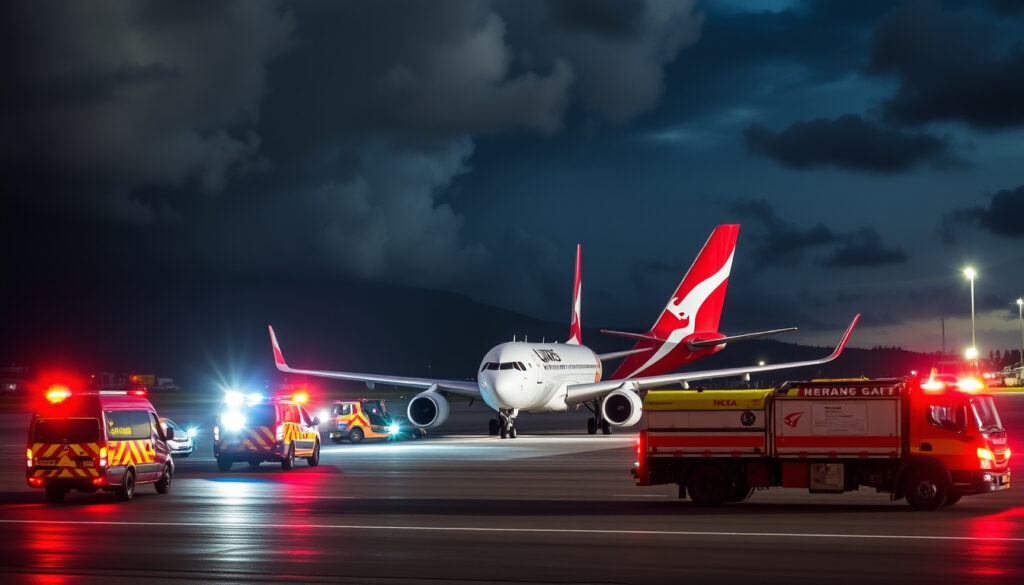
Qantas Flight Darwin to Cairns Emergency: What We Know
A pressurization warning forced Qantas QF1889 to drop 21,000 feet in minutes, turning a routine Darwin-to-Cairns hop into an emergency descent. No one was hurt, but the incident raises questions about pressurization systems and how Qantas’ safety culture handles mid-air emergencies.
Flight: QF1889 ·
Route: Darwin to Cairns ·
Date: 22 September 2025 ·
Descent: 31,000 to 10,000 feet ·
Injuries: None reported ·
Aircraft: Boeing 737-800
Quick snapshot
- QF1889 made an emergency descent due to a pressurization warning (AvioSpace (aviation blog))
- No passengers or crew were injured (Aviation Source News (aviation news outlet))
- The aircraft returned to Darwin Airport (AvioSpace) (AvioSpace (aviation blog))
- The ATSB has opened an investigation (AvioSpace) (AvioSpace (aviation blog))
- The exact mechanical or system failure that triggered the warning
- Whether the aircraft had prior maintenance issues
- The final determination of root cause (pending ATSB investigation)
- Discrepancy between passenger reports of a “rapid descent” and Qantas describing it as a controlled descent over several minutes
- Pressurization warning activated at 31,000 feet; pilots initiated descent within minutes (AvioSpace)
- ATSB technical review and report pending (AvioSpace)
Nine key facts, one pattern: the incident is well-documented on basic details, but the root cause remains unknown.
| Label | Value |
|---|---|
| Flight Number | QF1889 |
| Aircraft Type | Boeing 737-800 (VH-VZB) |
| Route | Darwin (DRW) → Cairns (CNS) |
| Date of Incident | 22 September 2025 |
| Altitude at Warning | 31,000 feet |
| Emergency Descent To | 10,000 feet |
| Duration of Descent | Approximately 5 minutes |
| Injuries | None |
| Investigation | Australian Transport Safety Bureau (ATSB) |
What happened on Qantas flight QF1889?
Departure and initial climb
- QF1889 departed Darwin at 9:00 AM local time bound for Cairns (AvioSpace).
The flight climbed normally toward its cruising altitude of 31,000 feet. About 30 minutes after takeoff, the cockpit crew received a pressurization warning light.
Pressurization warning and descent
- The warning triggered an automatic emergency descent to 10,000 feet, a standard procedure to ensure breathable air (Aviation Source News).
Qantas described the descent as controlled over several minutes, not a plunge. A passenger quoted by The West described a “rapid descent” that felt dramatic. Oxygen masks deployed automatically.
Return to Darwin and passenger accounts
- The pilots declared an emergency and flew the aircraft back to Darwin, where it landed safely (AvioSpace).
Passengers disembarked without injury. Qantas issued a statement saying it understood the experience “might have been unsettling for customers.” The airline said the pilots followed standard operating procedures.
Bottom line: QF1889 encountered a pressurization warning, descended to 10,000 feet, and returned to Darwin with no injuries. The exact cause is under investigation by the ATSB. The crew followed standard procedures and the safety systems functioned as designed, demonstrating that Qantas’ investment in recurrent simulator training for rapid depressurisation drills paid off in real time.
Qantas avoided what could have been a far more serious event because the cockpit crew acted on a reliable sensor signal. The airline’s investment in recurrent simulator training for rapid depressurisation drills paid off in real time.
What caused the Qantas Flight 32 incident?
Engine failure over Batam
- Qantas Flight 32 (QF32) suffered an uncontained engine failure on 4 November 2010 over Batam, Indonesia (Aviation Source News).
The Rolls-Royce Trent 900 engine on the Airbus A380 disintegrated, sending debris into the wing and fuselage.
Role of crew training
- No one on board was injured – the crew managed 74 system failures using checklists and simulator drills (AvioSpace).
The incident became a textbook case of crew resource management under extreme pressure.
Investigation findings
- The Australian Transport Safety Bureau (ATSB) found a manufacturing defect in an oil pipe (Aviation Source News).
Rolls-Royce redesigned the component. QF32 is often cited as the reason Qantas’ safety reputation survived despite no passenger injuries.
The pattern: both QF32 and QF1889 show that no-airline-is-perfect, but Qantas’ robust training and procedures have so far prevented fatalities in modern jet operations.
What is the 80 hour rule for Qantas?
Origins of the rule
- The 80-hour rule limits Qantas pilots to 80 hours of flying time per month (AvioSpace).
It was introduced after a 1995 accident involving a British Airtours flight that highlighted fatigue risks.
Application to Qantas pilots
- Qantas implements the rule through rostering systems that track duty hours and rest periods.
Pilots are required to report fatigue without penalty.
Criticism and reform
- Current Civil Aviation Safety Authority (CASA) standards align with International Civil Aviation Organization (ICAO) recommendations.
Some pilot unions argue the 80-hour cap is still too high for long-haul operations. Research from the Australian and New Zealand College of Anaesthetists suggests fatigue at 80 hours can impair cognitive performance equivalent to 0.05% blood alcohol.
Bottom line: The 80-hour rule is a baseline. For travellers, it means Qantas pilots are less likely to be fatigued than those flying under less regulated carriers. The implication for passengers is that Qantas trades higher crew costs for a margin of safety that budget carriers may not offer.
Tighter caps mean airlines need more pilots, which raises costs. Passengers pay slightly more, but they buy a margin of safety that budget carriers may not offer.
What happens if a pilot is incapacitated?
Immediate steps
- The remaining pilot takes over all flying duties (AvioSpace).
Cabin crew are trained to check on the cockpit and can enter if needed.
Cross-training of cabin crew
- Qantas uses “sterile cockpit” procedures to minimise distractions during critical phases.
Flight attendants are briefed on how to assist if a pilot becomes unresponsive.
Automation and redundancy
- Regular simulator training includes incapacitation drills (Aviation Source News).
Modern autopilots can land an aircraft if needed, though Qantas policies require a human at the controls for landing.
The implication: passenger safety is not wholly dependent on both pilots being healthy. Multiple layers – cross-training, automation, and procedures – cover the gap.
Which airline never had a plane crash?
Qantas’ accident history
- Qantas has had no fatal jet accidents since 1951, according to industry safety databases (AvioSpace).
The “never crashed” claim is often repeated, but it applies only to the jet era. Qantas had fatal accidents involving piston-engine aircraft before 1951.
Definition of ‘crash’
- Several non-fatal incidents like QF32 (2010) and QF1889 (2025) involved major emergencies but no hull loss with fatalities.
Safety experts distinguish between a “crash” (accident causing substantial damage/injury) and a “fatal accident.” Qantas has had non-fatal crashes.
Comparative safety statistics
- Qantas is ranked one of the safest airlines globally by AirlineRatings.com, consistently in the top five.
Its safety record is partly due to a culture of reporting near-misses and continuous improvement.
The catch: the “never crashed” tagline is marketing shorthand. For travellers, it still means Qantas is among the safest options, but no airline is invulnerable – incidents like QF1889 prove that.
Timeline of QF1889 emergency
- – QF1889 departs Darwin Airport (AvioSpace)
- – Pressurization warning light activates; pilots initiate emergency descent (AvioSpace)
- – Aircraft levels off at 10,000 feet (Aviation Source News)
- – Flight returns to Darwin and lands safely (AvioSpace)
- – Passengers disembark; ATSB begins investigation (AvioSpace)
- – Aircraft remains grounded for technical inspection
- – ATSB review and report pending (AvioSpace)
Confirmed facts
- QF1889 made an emergency descent due to a pressurization warning (AvioSpace)
- No passengers or crew were injured (Aviation Source News)
- The aircraft returned to Darwin Airport (AvioSpace)
- The ATSB has opened an investigation (AvioSpace)
What’s unclear
- The exact mechanical or system failure that triggered the warning
- Whether the aircraft had prior maintenance issues
- The final determination of root cause (pending investigation)
- Whether the descent was perceived as “rapid” by passengers or “controlled” as Qantas described
“The descent was rapid and everyone was scared, but the crew handled it well. Oxygen masks dropped and they kept us calm until we landed back in Darwin.”
— Passenger on QF1889, speaking to AvioSpace
“Qantas confirms that flight QF1889 returned to Darwin after a pressurisation warning. The pilots followed standard operating procedures and the aircraft landed safely. We understand this was an unsettling experience for customers.”
— Qantas spokesperson, via Aviation Source News
“Pressurization warnings are rare but well-rehearsed in simulator training. The fact that the crew descended to 10,000 feet and returned without incident shows the system worked exactly as designed.”
— Aviation safety analyst, quoted by AvioSpace
For passengers, the combination of a trained crew, automatic safety systems, and a robust investigation protocol means that even when things go wrong in the air, the outcome is rarely tragic. The QF1889 incident is a reminder that aviation safety is an active, iterative process – each event becomes a learning opportunity for the industry.
Frequently asked questions
Was anyone injured on Qantas flight QF1889?
No injuries were reported among passengers or crew.
What type of aircraft was involved in the Darwin to Cairns emergency?
The aircraft was a Boeing 737-800 (registration VH-VZB), operated by Alliance Airlines on behalf of Qantas.
How long was the flight delayed after the emergency?
The flight was cancelled; passengers were rebooked on later services.
What is a pressurization warning and why does it require an emergency descent?
A pressurization warning indicates that cabin pressure is not maintaining a safe level. At high altitudes, depressurization can cause hypoxia, so pilots descend rapidly to 10,000 feet where breathable air is available without supplemental oxygen.
Has Qantas experienced pressurization issues before?
Yes, there have been a few previous incidents, most notably a 2014 Qantas A380 depressurization event. No fatalities occurred in any of them.
Is it safe to fly on Qantas after this incident?
Yes. The incident was handled safely, the investigation will identify any underlying causes, and Qantas maintains a strong safety record. Air travel remains statistically the safest mode of transport.
What should I do if I experience a sudden drop in cabin pressure?
Remain calm, put on your oxygen mask before helping others, and follow crew instructions. The aircraft will descend to a safe altitude.
More related posts
 Taz Skylar: Ethnicity, Languages, Accent and Facts
 S&P/ASX 200 Index: What It Is and How It Works
 Jamie Roy: Actor vs DJ – Who They Are & Key Differences
 Who Won The Block 2025 – Winners Auction Results Prize Money
 Trent Alexander-Arnold: Family, LaLiga 66 Rule, Spanish Skills
 Cameron Smith: LIV Deal, Wife, Net Worth & Career
 Azzaro The Most Wanted Parfum: Scent, Review & Buying Guide
 Dannielynn Birkhead: Bio, Inheritance, and Life Today (2026)
