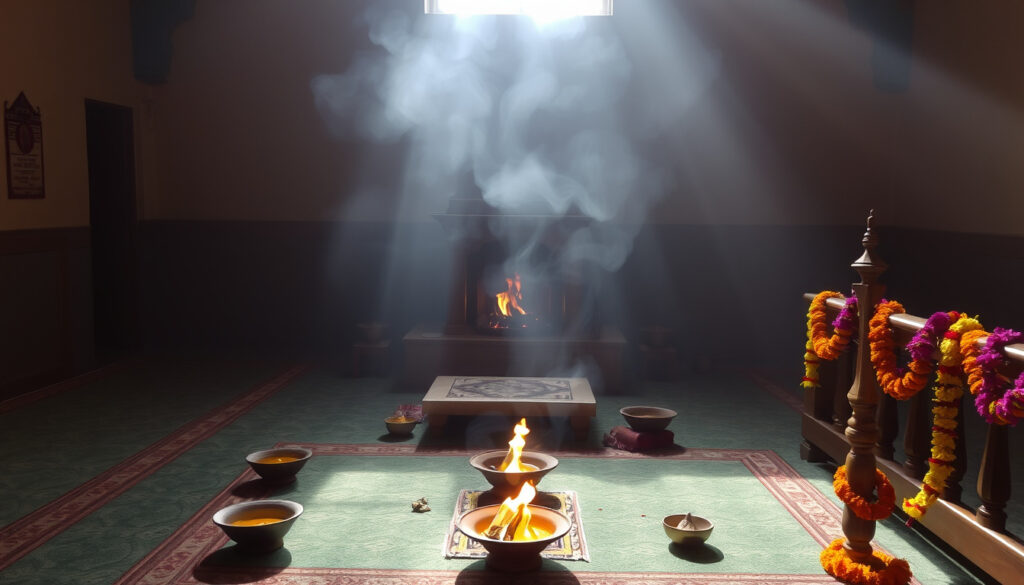
Shirdi Sai Baba: Saint, Teachings, Miracles, and Legacy
You’ve likely seen his image: a bearded figure in a flowing robe, seated in quiet repose. Few religious figures inspire such devotion across religious lines, yet the facts of Sai Baba’s life remain surprisingly elusive, claimed by Hindus and Muslims alike and built on miracle stories and syncretic ideals.
Birth year: 1838 or 1835 (unclear) ·
Known as: Sai Baba of Shirdi ·
Primary teaching: Unity of God and service to humanity ·
Number of temples: Over 1,000 worldwide ·
Major festival: Vijayadashami (Samadhi day) ·
Followers estimate: Millions globally
Quick snapshot
- Sai Baba lived in Shirdi from the 1850s until 1918 (Shree Saibaba Sansthan Trust)
- He taught charity, forgiveness, and religious tolerance (Bucknell University research paper)
- His followers include both Hindus and Muslims (National University of Singapore working paper)
- His exact birth year (estimates range from 1835 to 1838) (Christian Research Institute)
- Whether miracle accounts are historically factual—no controlled verification exists (Psi Encyclopedia)
- His formal religious affiliation: he accommodated both Hindu and Muslim rituals (Wikipedia)
- The earliest documented reference to Sai Baba in Shirdi is around 1854 (Shree Saibaba Sansthan Trust)
- Death recorded as October 15, 1918 (Wikipedia)
- Temple construction and global devotion expanded rapidly after 1920s (Psi Encyclopedia)
- Shirdi temple attracts over 25,000 pilgrims daily (Shree Saibaba Sansthan Trust)
- Academic studies continue to analyze syncretism in the Sai Baba movement (NUS working paper)
- Sathya Sai Baba (distinct figure) died in 2011 but his organization remains active (Wikipedia)
Six key facts about Shirdi Sai Baba: the known details are sparse, but the pattern of devotion is unmistakable.
| Fact | Detail |
|---|---|
| Full name | Unknown (often given as Sai Baba of Shirdi) |
| Birth date | 1838 or 1835 (speculative) |
| Death date | October 15, 1918 |
| Place of death | Shirdi, Maharashtra, India |
| Religion | Spiritual, not formally Hindu or Muslim |
| Key text | Shri Sai Satcharitra |
What is Sai Baba known for?
Shirdi Sai Baba is best known as a spiritual master who taught love, forgiveness, and charity. His message: serve the poor, respect all faiths, and trust in one God. The Shree Saibaba Sansthan Trust (the official temple authority) describes his mission as giving “blessings without discrimination.”
Core teachings of Shirdi Sai Baba
- Sai Baba emphasized the unity of all faiths, telling followers it does not matter which religion one belongs to, only that one be a good member of that religion (Psi Encyclopedia)
- He insisted on charity and compassion toward the poor, which remains central to his devotional tradition (Shree Saibaba Sansthan Trust)
- Devotional posters often portray him as embodying both the Vedas and Allah, pointing to a reconciliation of opposites (Bucknell University research paper)
Sai Baba’s emphasis on charity and compassion
The Shree Saibaba Sansthan Trust records that his mission included healing the sick, saving lives, protecting the vulnerable, and facilitating aid for the needy. This practical focus on service, rather than theology, is what drew—and continues to draw—followers across religious boundaries.
Sai Baba’s teachings are universally inclusive, yet his followers often claim him exclusively: Hindus see a Hindu saint, Muslims see a Sufi mystic. The movement’s glue is not doctrine but devotion to a figure who rejected labels entirely.
The pattern: Sai Baba’s appeal lies precisely in his ambiguity. Because he never declared himself Hindu or Muslim, devotees from both traditions can project their own framework onto him.
Is Sai Baba a God or a saint?
This question divides even his followers. The Shree Saibaba Sansthan Trust presents him as “a saint worshipped as God incarnate” and one who is “the embodiment of the Supreme Spirit.” But Sai Baba himself reportedly rejected divine claims.
Hindu perspective on Sai Baba’s divinity
- Many Hindu devotees treat him as an avatar (divine incarnation) of God (Bucknell University research paper)
- Temples across India and abroad install his idol alongside Hindu deities (Shree Saibaba Sansthan Trust)
- His images are used in Hindu prayer rooms and rituals daily
Muslim perspective on Sai Baba’s status
- Muslim devotees often revere him as a Sufi saint or a wali (friend of God) (National University of Singapore working paper)
- He lived in a mosque (Dwarakamai), kept a fire burning, and recited the Quran daily (Shree Saibaba Sansthan Trust)
- Yet mainstream Islamic authorities do not recognize saint worship
Debate among devotees and scholars
A working paper from the National University of Singapore argues that the Sai Baba movement is best understood as a “syncretistic framework” that combines Hindu and Indian cultural elements with universalist ideals—not simply a variant of Hinduism. This means the question “God or saint?” may miss the point: Sai Baba functions as a divine figure for practical devotion, regardless of theological classification.
The catch: Devotees need not choose. The movement’s ecumenical nature allows each follower to hold their own view—and Sai Baba’s silence on the matter leaves the question permanently open.
What miracles did Sai Baba perform?
The miracle accounts of Shirdi Sai Baba and Sathya Sai Baba are distinct yet often confused. For Shirdi Sai Baba, stories were collected after his death in texts like the Shri Sai Satcharitra, compiled by a devotee named Hemadpant in 1922. For Sathya Sai Baba (1926–2011), miracles were performed publicly and caught on video.
Famous miracles: lighting lamps with water
- Shirdi Sai Baba is said to have lit lamps using water instead of oil, according to oral tradition (Shree Saibaba Sansthan Trust)
- Sathya Sai Baba was widely known for materializing sacred ash (vibhuti), rings, and small statues from thin air (Wikipedia)
- The Psi Encyclopedia notes that Sathya Sai Baba refused controlled experiments, insisting his miracles served spiritual purposes, not scientific demonstration
Healing the sick and feeding the hungry
- Numerous anecdotes describe Shirdi Sai Baba healing devotees and averting accidents (Shree Saibaba Sansthan Trust)
- The Christian Research Institute reports that Sathya Sai Baba’s public stunts included pouring ash from an empty urn
- No scientific verification exists for any of these claims
Miracles are the engine of devotional momentum. But they are also the source of controversy: without verification, critics see conjuring; believers see the divine. The absence of evidence has not diminished the devotion—a pattern that defines faith movements worldwide.
The trade-off: For believers, the stories are self-authenticating. For skeptics, they are the reason to dismiss the entire tradition. The movement survives because it does not require believers to choose—they can accept miracles as metaphors or as literal acts of God.
Why do people pray to Sai Baba?
Prayer to Sai Baba spans practical requests and spiritual seeking. The Shree Saibaba Sansthan Trust lists his mission as granting offspring, facilitating financial gain, and saving lives—essentially, a divine problem-solving service.
Seeking blessings for health and wealth
- Thousands of devotees visit Shirdi daily with petitions for health, jobs, and family stability (Shree Saibaba Sansthan Trust)
- Online prayer groups on social media share “prayer requests” and testimonies of answered prayers
- The Sai Satcharitra recounts numerous instances of Sai Baba intervening in devotees’ worldly affairs
Spiritual guidance and inner peace
- For many, Sai Baba represents unconditional love and acceptance, offering a path to inner peace (NUS working paper)
- His teachings emphasize surrender to God (Shraddha) and patience (Saburi), which function as a practical spiritual toolkit
- The movement allows adherents to keep the religious practices of their parent tradition while adding Sai Baba devotion (National University of Singapore working paper)
Community and temple practices
- The Shirdi temple complex hosts daily aarti (prayer ceremonies), bhandara (community feasts), and festivals
- Over 1,000 Sai Baba temples exist worldwide, from the United Kingdom to Australia to Singapore
- Annual festivals like Vijayadashami and Ramnavami attract millions to Shirdi
What this means: Sai Baba functions as a universal spiritual intermediary—accessible to anyone regardless of religion, caste, or background. This is the key to his global appeal: he solves practical problems without demanding doctrinal alignment.
What did Sai Baba say about Jesus and Muslims?
Sai Baba’s teachings explicitly supported Muslim practices and showed respect for Jesus, though his exact views remain filtered through devotional literature.
Sai Baba’s view on Jesus
- No direct recorded statements from Sai Baba about Jesus exist, but he is known to have referenced Christian teachings on charity and compassion (Christian Research Institute)
- The Christian Research Institute notes that his teachings attempted to “synthesize truth from all great faiths, with special emphasis on Christian charity”
- Some devotional sources claim he spoke of Jesus as a great teacher, but these are not verified
Sai Baba’s support for Muslim practices
- Sai Baba lived in a mosque (Dwarakamai) and maintained Muslim customs such as daily Quran reading (Shree Saibaba Sansthan Trust)
- He allowed Hindu and Muslim rituals side by side, including prayer, offerings, and feeding of the poor (Bucknell University research paper)
- His dress—a knee-length kafni robe—reflected Muslim ascetic tradition
Syncretism as a core teaching
- The movement is described as practicing “ethno-religious ecumenism,” allowing followers to keep their original religious identities (NUS working paper)
- Devotional posters portray him as simultaneously embodying Hindu and Muslim symbols (Bucknell University paper)
- He is understood as “neither Hindu nor Muslim, but both” (Bucknell University paper)
The implication: Sai Baba’s syncretism was not academic—it was practiced in daily rituals. His mosque-temple hybrid was a living experiment in interfaith harmony, one that continues to thrive despite rising religious polarization in India.
Why do some people criticize Sai Baba?
Criticism of “Sai Baba” often confuses two different figures. The controversy is mostly about Sathya Sai Baba (1926–2011), who faced allegations of fraud, sexual abuse, and financial misconduct. Shirdi Sai Baba (1838–1918) also attracts criticism, but of a different kind.
Sathya Sai Baba controversy
- The Psi Encyclopedia summarizes accusations against Sathya Sai Baba as including conjuring (sleight of hand), sexual abuse, and financial fraud
- Critics described his materializations of vibhuti and trinkets as stage magic, not supernatural (Wikipedia)
- The Christian Research Institute states that critics challenged these miracle claims “for decades” and that the allegations are “not new”
Skepticism about miracles
- Shirdi Sai Baba’s miracle accounts rely entirely on devotional texts written after his death (Shri Sai Satcharitra, 1922)
- No contemporary documentation or independent verification exists for any of his alleged miracles
- The Psi Encyclopedia notes that Sathya Sai Baba “refused controlled experiments” for scientific testing
Religious purity debates
- Orthodox Hindus criticize the mixing of Hindu and Muslim rituals as a dilution of both traditions
- Some Muslim scholars reject saint veneration as un-Islamic (NUS working paper)
- Christian missionary critiques label the movement as New Age syncretism without theological depth (Christian Research Institute)
Upsides
- Accessible spirituality: no conversion required, no rigid doctrines
- Practical benefits: community support, charity, and a sense of divine protection
- Interfaith appeal: Hindus and Muslims can worship together
Downsides
- Historical uncertainty: no verified biography; birth year and birthplace unknown
- Miracle stories lack verification; vulnerable to fraud allegations—especially regarding Sathya Sai Baba
- Religious ambiguity alienates orthodox practitioners of both Hinduism and Islam
Timeline of key events
Five events span Sai Baba’s life and legacy, though exact dates for his early years remain speculative.
- 1838–1835: Birth of Sai Baba in or near Shirdi (Shree Saibaba Sansthan Trust)
- ~1854: Arrival in Shirdi as a young ascetic (Shree Saibaba Sansthan Trust)
- Late 1800s: Gathering of followers; miracles reported (Shree Saibaba Sansthan Trust)
- 1915: Construction of Dwarakamai mosque (Shree Saibaba Sansthan Trust)
- October 15, 1918: Death (Samadhi) of Sai Baba (Wikipedia)
The pattern: The most significant event in Sai Baba’s timeline is not a birth or a miracle—it is his death. The Samadhi temple built on his grave became the epicenter of a global movement. His posthumous following vastly exceeds his living one.
Key quotes about Sai Baba
“It does not matter to which faith a person belongs, only that they be a good member of that religion.”
— Sai Baba, as recorded in the Psi Encyclopedia
“Devotional posters portray Shirdi Sai Baba as embodying both the Vedas and Allah, pointing to a reconciliation of opposites—neither Hindu nor Muslim, but both.”
— Bucknell University academic paper
“His mission: giving blessings without discrimination, healing the sick, saving lives, and facilitating financial gain for devotees.”
— Shree Saibaba Sansthan Trust, Shirdi (official temple authority)
Sai Baba of Shirdi remains one of India’s most beloved yet least-documented spiritual figures. For the millions who pray at his temples, factual ambiguity matters less than felt presence. For skeptics, the lack of evidence is the point. The legacy of this syncretic saint—claimed by Hindus, Muslims, and spiritual seekers alike—will likely continue to grow precisely because he refuses to be pinned down. For anyone trying to understand Indian spirituality today, the choice is clear: engage with the contradictions, or miss the story entirely.
en.wikipedia.org, bdsteel.tripod.com, westernchanfellowship.org
For a deeper look into Sai Babas life and miracles, readers can explore how his syncretic message continues to inspire millions across faiths.
Frequently asked questions
What is Sai Baba’s real name?
His real name is unknown. He adopted the name “Sai Baba” after arriving in Shirdi. “Sai” derives from Persian or Arabic meaning “friend” or “holy one,” and “Baba” means father or saint (Shree Saibaba Sansthan Trust).
Where is Sai Baba’s temple?
The main temple is in Shirdi, Maharashtra, India. Over 1,000 temples exist worldwide, including in the UK, USA, Australia, and Singapore.
When did Sai Baba die?
October 15, 1918 (Wikipedia). His death is commemorated as Vijayadashami Samadhi Day.
Does Sai Baba have a photo?
Yes, a black-and-white photograph taken in the early 1900s shows Sai Baba seated cross-legged. This image is widely used in temples and homes.
What is the famous line of Sai Baba?
“Shraddha Saburi” (Faith and Patience) is his most quoted teaching, emphasizing trust in God and patient endurance (Shree Saibaba Sansthan Trust).
Who is Sathya Sai Baba?
A separate figure born in 1926 in Puttaparthi, India, who claimed to be the reincarnation of Shirdi Sai Baba. He faced allegations of fraud and abuse (Wikipedia).
Is Sai Baba a Hindu or Muslim?
He is neither formally—he lived in a mosque (Dwarakamai) while using Hindu and Muslim ritual elements. Academic research describes him as a syncretic figure (Bucknell University).
Related reading
- Shiva God: Roles, Facts, Names, and Comparisons – A detailed look at a major Hindu deity whose traditions intersect with Sai Baba devotion
- Florence Nightingale: The Lady with the Lamp, Nursing Founder – Another historical figure revered for healing and selfless service
More related posts
 Movies Near Me: Irish Cinema Listings, Top Films & Policies
 Cameron Smith: LIV Deal, Wife, Net Worth & Career
 Harvey Norman Maitland – Hours, Location, Services & Reviews
 Kristen Stewart: From Twilight to Queer Icon
 Patrick Carrigan: Bio, Salary, Suspension & Career Stats
 Malcolm-Jamal Warner Death: Cause, Family & Tributes
 When Do Babies Start Talking – Age-by-Age Milestones Guide
 Jeremy Rockliff: Biography, Wife, Net Worth, Family & Contact
